Blog
All
Mobile Accessories Guide
power bank

All

How Charging Protocol Negotiation Decides What Power a Device Actually Gets

A charger’s printed wattage is only an upper limit. Real charging power depends on protocol negotiation between the charger, device, and cable, along with battery level, heat, and safety controls.

Apr 16,2026

How Charging Protocol Negotiation Decides What Power a Device Actually Gets

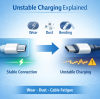
Why Some Cables Start Charging Only After You Move the Connector

If a cable only starts charging after you move the connector, the problem is usually an unstable electrical connection. Worn contacts, dirt, oxidation, internal cable damage, or a loose port can all make charging work only at certain angles.

Apr 14,2026

Why Some Cables Start Charging Only After You Move the Connector

Why a Phone Battery Sometimes Drops Faster Between 20% and 10%

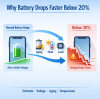
Phone battery percentage is only an estimate, so the drop from 20% to 10% can feel faster than other ranges. Battery aging, voltage drop under load, temperature, and calibration all make low-battery behavior less stable and more noticeable.

Apr 13,2026

Why a Phone Battery Sometimes Drops Faster Between 20% and 10%

Why Product Size Matters More Than People Expect in Portable Accessories

In portable accessories, size affects daily comfort, convenience, and long-term use more than many people expect. A product may look strong on paper, but if its shape or dimensions do not fit real routines, people are less likely to keep using it.

Apr 9,2026

Why Product Size Matters More Than People Expect in Portable Accessories

Why People Keep Replacing Cables Again and Again

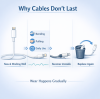
People replace charging cables frequently not because they suddenly fail, but because they gradually become inconvenient to use. Daily habits, repeated stress, and slow wear reduce reliability over time, leading to a continuous replacement cycle.

Apr 2,2026

Why People Keep Replacing Cables Again and Again

What Actually Causes Cable Looseness and Unstable Charging Over Time

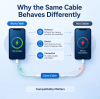
The same charging cable can perform differently across devices due to protocol compatibility, device power management, cable design, and connection quality. Real charging performance depends on the entire system, not just the cable itself.

Mar 31,2026

What Actually Causes Cable Looseness and Unstable Charging Over Time

What Actually Causes Cable Looseness and Unstable Charging Over Time

Cable looseness and unstable charging usually result from connector wear, internal fatigue, contamination, and tolerance changes over time. Stable charging depends not only on power ratings, but also on the physical integrity of the connection.

Mar 30,2026

What Actually Causes Cable Looseness and Unstable Charging Over Time

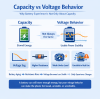
Why Battery Voltage Behavior Can Matter More Than Capacity in Daily Use

Battery capacity tells you how much energy is stored, but battery voltage behavior often has a bigger impact on real daily experience. A battery can still show acceptable capacity while already becoming unstable under load, which can lead to sudden percentage drops, weak performance, and unexpected shutdowns even before runtime looks dramatically worse.

Mar 27,2026

Why Battery Voltage Behavior Can Matter More Than Capacity in Daily Use

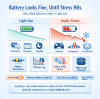
Why a Phone Battery Can Seem Fine in Daily Use but Fail Under Stress

A phone battery can seem fine during light daily use but fail under stress because light tasks do not fully reveal its real condition. High-load situations such as gaming, navigation, camera use, cold weather, and fast charging can expose hidden weaknesses like rising internal resistance, unstable voltage, and reduced power delivery.

Mar 25,2026

Why a Phone Battery Can Seem Fine in Daily Use but Fail Under Stress

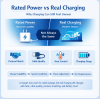
Why a Charger Can Reach Rated Power but Still Deliver Uneven Real Charging

A charger can reach its rated power and still deliver uneven real charging because rated wattage only shows maximum capability, not constant real-world output. Actual charging performance changes with protocol matching, cable quality, battery temperature, charging stage, and device-side power management.

Mar 23,2026

Why a Charger Can Reach Rated Power but Still Deliver Uneven Real Charging

Why Battery Aging Affects Stability Before It Affects Capacity

Battery aging does not only reduce capacity over time. It often affects stability first by increasing internal resistance, weakening voltage behavior, and making charging and discharging less predictable, which is why an old battery may feel unstable before its total runtime becomes obviously poor.

Mar 20,2026

Why Battery Aging Affects Stability Before It Affects Capacity

How USB-C Charging Negotiation Decides Real Power Delivery

USB-C charging speed is determined by negotiation, not by charger wattage alone. Real power delivery depends on protocol support, cable capability, device charging limits, battery temperature, and charging stage, which is why the same charger can produce different results on different devices.

Mar 19,2026

How USB-C Charging Negotiation Decides Real Power Delivery

Why Your Phone Still Charges Slowly With a High-Watt Charger

A high-watt charger does not automatically guarantee faster charging. Real charging speed depends on the phone’s charging limit, protocol compatibility, cable quality, battery temperature, and current charging stage, so the whole charging system matters more than the wattage label alone.

Mar 18,2026

Why Your Phone Still Charges Slowly With a High-Watt Charger

Why a Bigger Power Bank Does Not Always Mean Better Charging Experience

A bigger power bank does not always mean a better charging experience. While higher capacity offers more stored energy, real-world usability also depends on portability, output speed, charging efficiency, heat control, recharge time, and compatibility with your devices.

Mar 16,2026

Why a Bigger Power Bank Does Not Always Mean Better Charging Experience