Why a Charger Can Reach Rated Power but Still Deliver Uneven Real Charging
- Share
- Issue Time
- Mar 23,2026
Summary
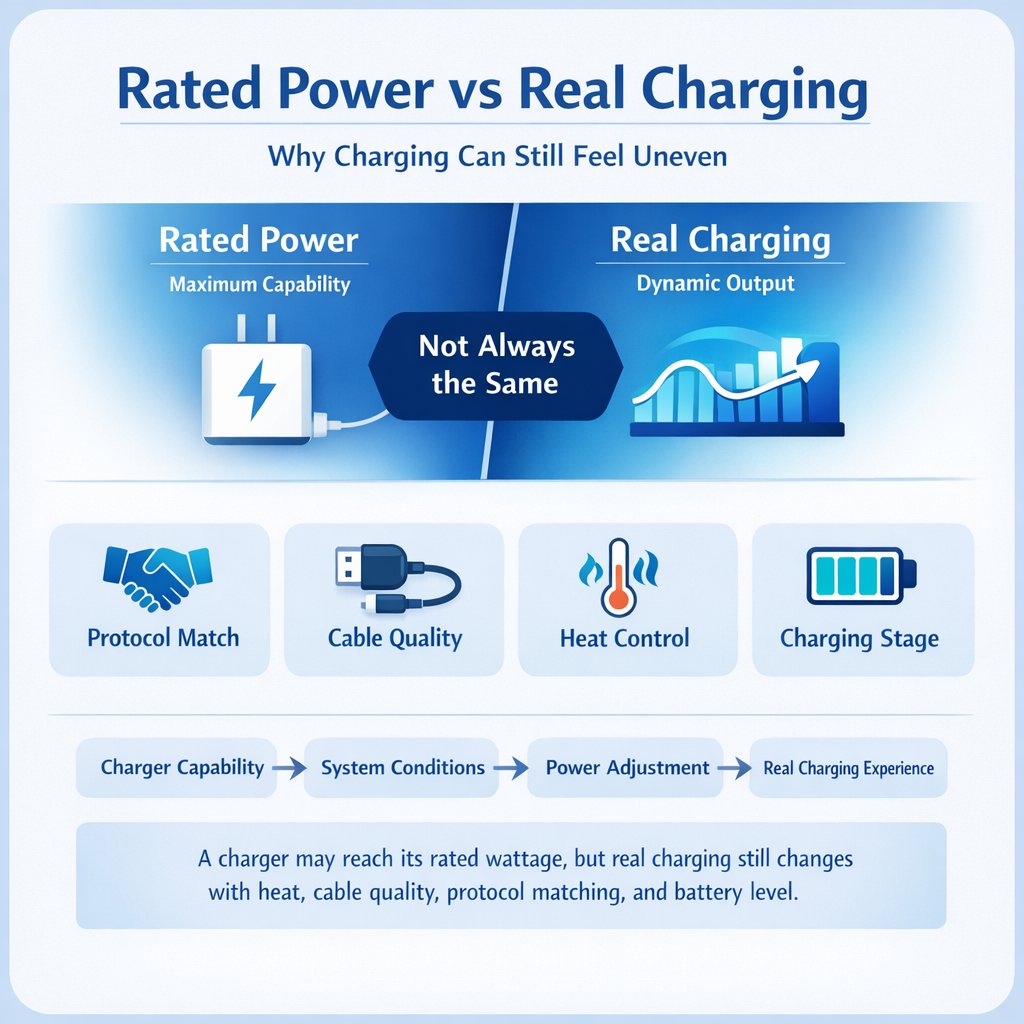
A charger can reach its rated power and still deliver uneven real charging because rated wattage only shows maximum capability, not constant real-world output. Actual charging performance changes with protocol matching, cable quality, battery temperature, charging stage, and device-side power management.
Why a Charger Can Reach Rated Power but Still Deliver Uneven Real Charging
Many users assume that once a charger reaches its rated wattage, charging performance should feel smooth and consistent. If a charger can output 30W, 65W, or 100W in testing, it seems reasonable to expect stable fast charging in daily use.
But real charging does not always feel that way. A charger may technically reach its rated power and still deliver uneven charging performance in real life. The speed may rise and fall, the phone may sometimes feel fast and sometimes slow, or charging may become less stable as conditions change.
This happens because rated power and real charging experience are not exactly the same thing.
Rated Power Is a Maximum, Not a Constant
The wattage printed on a charger shows the maximum power it can deliver under supported conditions. It does not mean the charger will output that power continuously in every situation.
Real charging depends on device compatibility, protocol negotiation, cable condition, battery temperature, charging stage, and internal power management. So a charger may be fully capable of reaching its rated number, while the actual charging process still changes from moment to moment.
Real Charging Is a Dynamic Process
Charging is not a fixed one-direction process where a charger pushes the same power level from start to finish. Instead, real charging is dynamic.
The charger and device constantly work together to adjust power based on current needs and safety conditions. As a result, actual charging may speed up, slow down, or stabilize differently during one single charging session.
- The battery level changes continuously
- The battery temperature can rise
- The device may switch charging profiles
- Internal safety logic may reduce accepted power
Protocol Matching Affects Stability
A charger may support high power on paper, but real charging still depends on whether the device can communicate properly through the required protocol.
Common factors include USB Power Delivery support, PPS support, proprietary fast charging systems, and supported voltage-current combinations. If protocol matching is incomplete, the device may fall back to a lower or less stable charging profile.
| Protocol Factor | Possible Effect on Real Charging |
|---|---|
| USB PD Support | Helps devices negotiate supported power profiles correctly |
| PPS Support | Can improve dynamic adjustment and charging smoothness |
| Brand-Specific Protocols | May prevent full-speed charging if the charger is not fully compatible |
| Voltage-Current Profiles | Mismatch can force the device into a lower or less stable mode |
Cable Quality Can Disturb Real Output
Many charging problems that feel like charger inconsistency are actually influenced by the cable. A cable with higher resistance, weak connectors, limited current rating, or unstable signal quality can reduce charging consistency.
Even when a charger is capable of high output, a weak cable may cause the system to lower power, fluctuate between profiles, or generate more heat. That is why real charging often depends on the full path, not the charger alone.
Heat Changes Power Delivery in Real Time
Thermal behavior is one of the biggest reasons charging can feel uneven. As a battery warms up, the device may reduce charging speed to protect battery health and maintain safety.
This means charging may begin quickly and then slow down because of high ambient temperature, heavy phone use while charging, battery aging, thick phone cases, or poor heat dissipation.
- Warm room temperature
- Gaming or video use while charging
- Old batteries that heat more easily
- Thick cases or poor airflow
Charging Speed Naturally Changes Across Battery Levels
A charger can also feel uneven simply because modern batteries do not charge at one constant speed. At lower battery levels, the system often allows higher charging power. As the battery fills, charging gradually slows down.
This is normal battery protection behavior. So even if a charger can reach its rated power, users may still notice fast charging at low battery, slower charging in mid to high battery range, and more visible power reduction near full charge.
Device Power Management Also Plays a Role
Modern phones and tablets use internal charging chips and battery management systems that decide how much power should be accepted at any given moment.
These systems consider battery condition, temperature, voltage behavior, current battery level, and device activity during charging. That means two devices using the same charger may show very different charging behavior, even if the charger itself performs correctly.
| Device-Side Factor | How It Changes Charging |
|---|---|
| Battery Condition | Older batteries may accept power less smoothly |
| Temperature | Higher heat can trigger earlier power reduction |
| Battery Level | Charging naturally slows as the battery gets fuller |
| Device Activity | Heavy use while charging can reduce accepted power |
Why Testing Results and Daily Experience Can Differ
Lab testing often measures whether a charger can achieve certain output levels under controlled conditions. Daily charging is much less controlled.
In real use, users may change cables, use the phone while charging, charge in warmer rooms, plug in at different battery levels, or connect devices with different protocol behavior. Because of that, a charger that performs perfectly in controlled tests may still feel uneven in daily life.
How to Improve Real Charging Consistency
If a charger feels uneven despite having strong rated power, users can improve results by focusing on the whole system.
In many cases, improving system matching matters more than chasing a higher wattage label.
Conclusion
A charger can reach its rated power and still deliver uneven real charging because rated wattage only describes maximum capability, not constant real-world output.
Actual charging performance changes with protocol matching, cable quality, battery temperature, charging stage, and device-side power management.
Understanding this helps users judge charging quality more realistically and choose accessories that work better together in everyday use.