Why Battery Voltage Behavior Can Matter More Than Capacity in Daily Use
- Share
- Issue Time
- Mar 27,2026
Summary
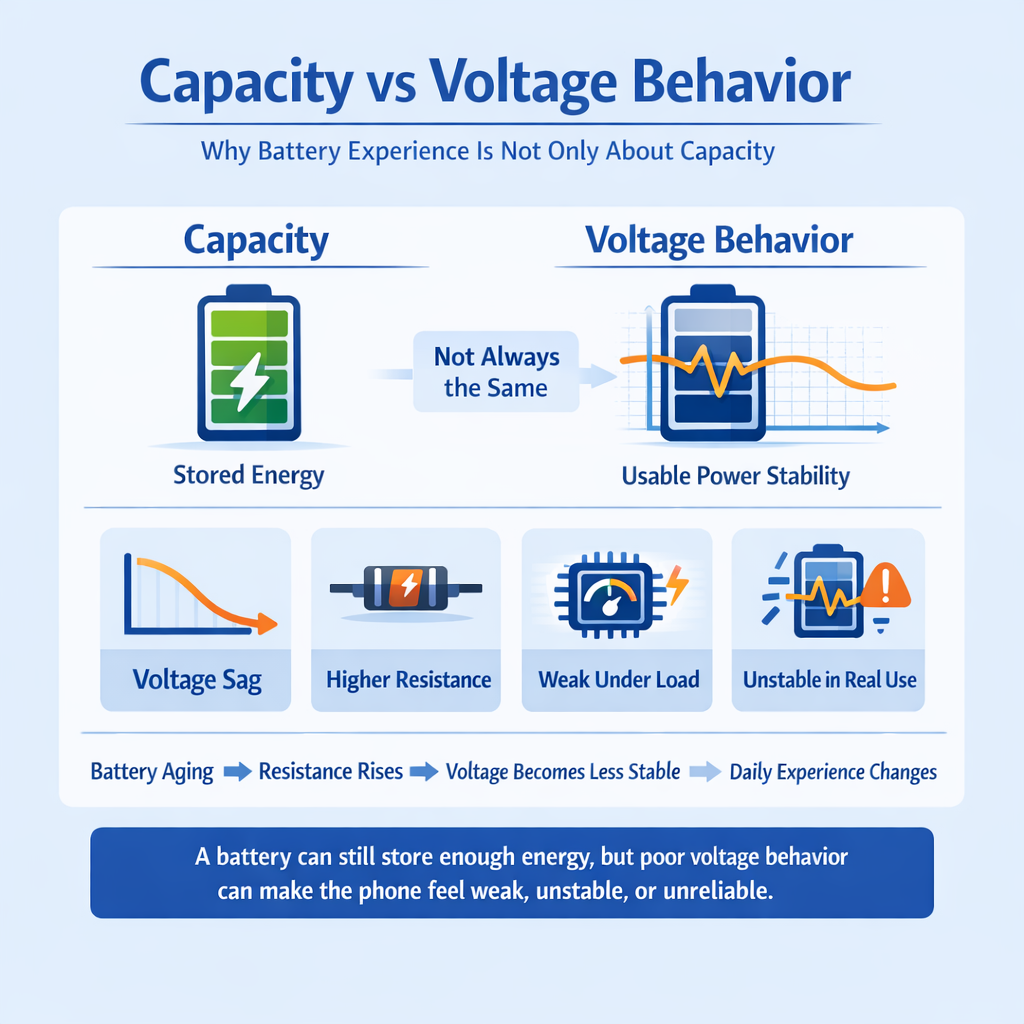
Battery capacity tells you how much energy is stored, but battery voltage behavior often has a bigger impact on real daily experience. A battery can still show acceptable capacity while already becoming unstable under load, which can lead to sudden percentage drops, weak performance, and unexpected shutdowns even before runtime looks dramatically worse.
Why Battery Voltage Behavior Can Matter More Than Capacity in Daily Use
When people judge a phone battery, they usually think about one thing first: capacity. If the battery still lasts a reasonable number of hours, many users assume the battery is still in good condition.
But in real daily use, capacity is not always the most important part of battery experience. A battery can still hold a fair amount of energy and yet feel unstable, inconsistent, or weak in real-world situations.
That is because what matters in many moments is not only how much energy the battery stores, but how well it can maintain voltage while the phone is using power.
Capacity Tells You How Much Energy, Not How Smoothly It Is Delivered
Battery capacity is about total stored energy. It affects how long a device can run before it needs to be charged again. That matters, of course.
But daily battery experience also depends on whether the battery percentage drops smoothly, whether the phone stays stable under load, whether it shuts down unexpectedly before 0%, and whether performance weakens when demand rises.
These problems are often more closely tied to voltage behavior than to pure capacity.
Phones Depend on Stable Voltage, Not Just Remaining Percentage
A smartphone does not operate only on the idea of remaining battery percentage. Internally, it depends on the battery delivering voltage within usable ranges.
If voltage drops too quickly under load, the phone may react as though the battery is much weaker than its remaining percentage suggests.
- Sudden battery percentage drops
- Lag or throttling during demanding tasks
- Early low-battery warnings
- Shutdowns before the battery appears empty
That is why two batteries with similar apparent capacity can produce very different user experiences.
Voltage Sag Under Load Is a Real Daily Problem
One of the most common signs of poor voltage behavior is voltage sag under load. When the phone suddenly needs more power, the battery has to respond quickly.
| High-Load Situation | Why Voltage Stability Matters |
|---|---|
| Gaming | The system needs sustained power and reacts quickly to voltage weakness |
| Camera Use | Power demand rises suddenly and can expose unstable voltage response |
| GPS Navigation | Screen, signal use, and processing load make battery weakness more visible |
| Outdoor High Brightness | Higher display load increases the need for stable battery output |
A healthy battery can maintain voltage more smoothly. An aging or weaker battery may show a sharper voltage drop, making the phone feel weak even when capacity still looks acceptable.
Internal Resistance Often Changes Voltage Behavior First
As a lithium battery ages, one of the earliest important changes is rising internal resistance. Higher internal resistance means the battery has more difficulty delivering power efficiently when the phone asks for more current.
Importantly, internal resistance can worsen before capacity loss becomes obvious. That is one reason voltage behavior can become a bigger real-life issue than capacity at certain stages of battery aging.
Why Battery Percentage Can Feel Misleading
Many users trust battery percentage as the main sign of battery condition. But battery percentage is only an estimate based on voltage, current flow, temperature, and system calculations.
If voltage behavior is unstable, percentage behavior may also become less reliable.
- Percentage staying normal during light use
- Sudden drops during heavy use
- Partial recovery after cooling down
- Different behavior in cold weather
In these situations, the capacity number alone does not fully explain the experience. Voltage behavior often explains it better.
Daily Use Often Exposes Voltage Problems Before Capacity Problems
In many phones, users notice battery weirdness before they notice major runtime loss.
The battery may still last most of the day, but the phone becomes weak under camera use, or battery drops quickly during navigation, or the device behaves much worse in cold weather.
This happens because moderate capacity loss can sometimes be hidden in normal routines, while unstable voltage becomes obvious as soon as the battery is stressed.
Temperature Makes Voltage Behavior More Important
Battery voltage behavior becomes even more important when temperature changes.
This means voltage behavior is not just a lab concept. It directly affects how a phone feels in travel, outdoor use, gaming, charging, and seasonal temperature changes.
Why Capacity Still Matters, But Is Not the Whole Story
This does not mean capacity is unimportant. Capacity still matters because it determines total runtime.
But in real daily use, users often care just as much about predictability, stability, load performance, shutdown behavior, and smooth battery percentage change.
A battery that stores less energy but remains stable may feel better than a battery with more remaining capacity but poor voltage behavior.
How to Recognize Voltage-Related Battery Weakness
Some warning signs suggest voltage behavior is becoming more important than capacity loss alone:
| Warning Sign | Possible Meaning |
|---|---|
| Battery drops quickly only during heavy tasks | Voltage response is weakening under load |
| Phone shuts down before 0% | The battery may be unable to maintain usable voltage |
| Cold weather makes behavior much worse | Voltage stability is highly stress-sensitive |
| Percentage looks acceptable but the phone feels weak | Stored energy may not be translating into stable usable power |
What Users Can Do
If voltage-related weakness is already appearing, users can reduce problems by improving charging and usage habits.
In many cases, battery replacement improves not only battery life, but also stability, percentage accuracy, and device behavior under load.
Conclusion
Battery capacity tells you how much energy is stored, but battery voltage behavior often tells you how usable that energy really is in daily life.
That is why voltage behavior can sometimes matter more than capacity in real use. A battery may still hold enough charge on paper, yet feel weak, unstable, or unreliable when the phone actually needs power.
Understanding this helps users judge battery condition more realistically and recognize early battery aging before the problem becomes obvious in total runtime.