Why Battery Aging Affects Stability Before It Affects Capacity
- Share
- Issue Time
- Mar 20,2026
Summary
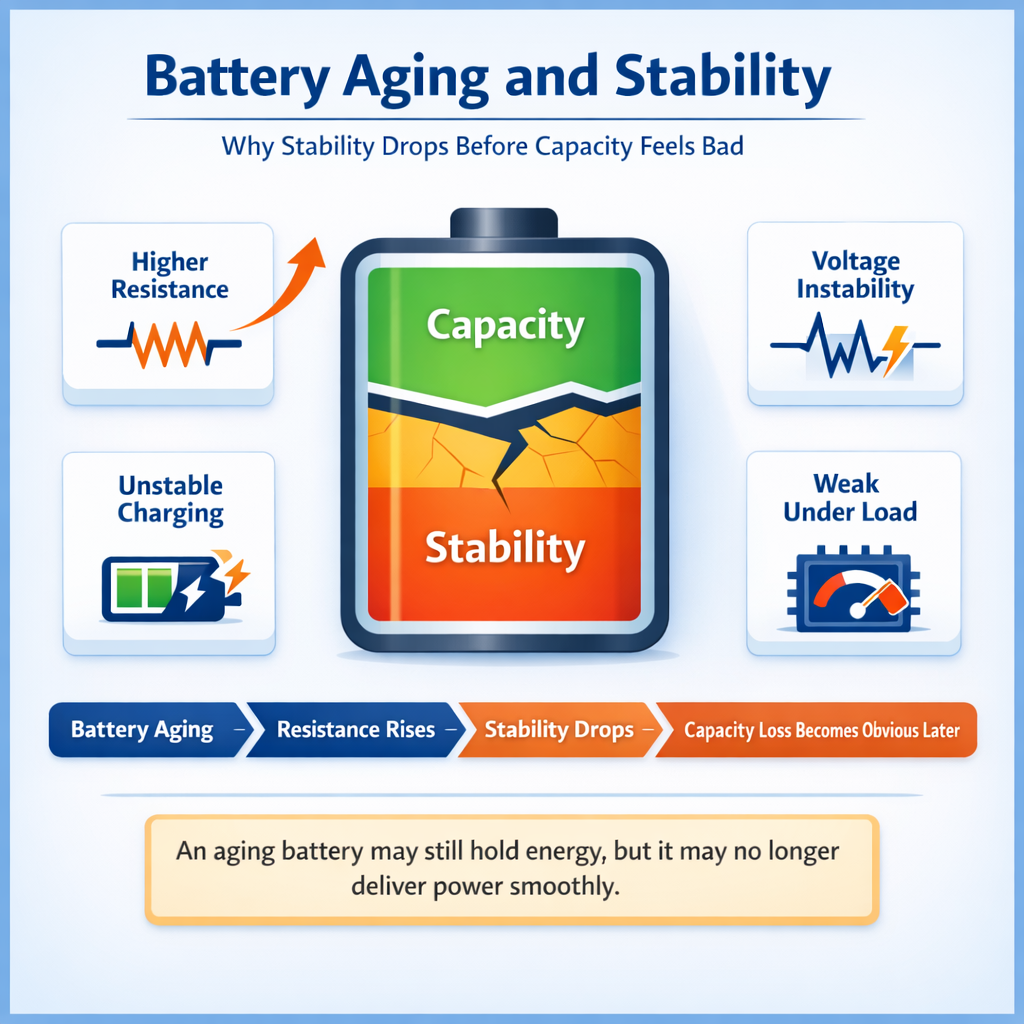
Battery aging does not only reduce capacity over time. It often affects stability first by increasing internal resistance, weakening voltage behavior, and making charging and discharging less predictable, which is why an old battery may feel unstable before its total runtime becomes obviously poor.
Why Battery Aging Affects Stability Before It Affects Capacity
Many people assume that battery aging becomes obvious only when battery life gets much shorter. But in real use, an aging phone battery often starts showing problems much earlier than that.
Before the battery loses a dramatic amount of capacity, it may already become less stable. The phone may feel less predictable, battery percentage may jump more easily, charging speed may vary more than before, and performance under load may get worse.
This happens because battery aging does not change only how much energy a battery can store. It also changes how steadily the battery can deliver and receive power.
Capacity Loss Is Only One Part of Battery Aging
When people talk about battery health, they usually focus on capacity. That makes sense because capacity determines how long a phone can run before needing to be charged again.
But battery aging also affects internal resistance, voltage stability, thermal behavior, charging response, and load handling. A battery can still hold a reasonable amount of energy while already becoming worse at managing real-world power conditions.
Internal Resistance Usually Rises First
One of the most important early aging changes is the increase in internal resistance. As a lithium battery ages, the movement of ions inside the cell becomes less efficient, making it harder for the battery to move energy smoothly during charging and discharging.
- Faster voltage drop under load
- More heat during charging
- Less stable power delivery
- Weaker performance at low temperature
These effects can become noticeable even when the battery still seems to have enough total capacity.
Stability Problems Often Show Up in Daily Use
An aging battery may start feeling unstable in ways that users notice before they clearly notice shorter runtime.
| Early Sign | What It Suggests |
|---|---|
| Battery Percentage Jumps | Voltage behavior is becoming less stable |
| Unexpected Shutdowns | The battery struggles under sudden or heavy load |
| Slower Charging | Thermal control or weaker charging response may be increasing |
| Extra Heat | Higher resistance is wasting more energy as heat |
Voltage Behavior Matters More Than Most Users Realize
Phones do not run directly on a simple remaining-power number. They depend on stable voltage coming from the battery.
As a battery ages and internal resistance rises, voltage may sag more quickly during demanding tasks such as camera use, gaming, GPS navigation, video streaming, or high-brightness outdoor use.
This can make the phone behave as if the battery is emptier than it really is. That is why a battery may still seem acceptable on paper but feel unstable in real use.
Aging Also Changes Charging Behavior
Battery aging affects charging, not just discharging. Older batteries often warm up faster while charging, reduce charging speed sooner, spend more time under thermal control, and respond less smoothly to fast charging.
Why Capacity Drops More Gradually Than Stability
Capacity loss is often more gradual and easier for software to smooth out in daily experience. Stability problems, however, can appear suddenly under certain conditions because they are tied to real-time stress such as temperature, load spikes, charging current, and battery voltage behavior.
A phone can hide moderate capacity loss fairly well, but it is harder to hide unstable voltage and rising resistance. This is one reason users often feel that the battery is acting strange before it is actually dead.
Cold Weather and Heavy Load Reveal Aging Faster
Battery aging tends to become more obvious when the battery is under stress. Two common stress conditions are low temperature and high power demand.
In cold weather, chemical reactions slow down. Under heavy load, the phone demands more power immediately. An aging battery with higher internal resistance handles both situations poorly.
- Outdoor use in cold weather
- Gaming or high-brightness operation
- Camera and video use
- Navigation and long active-screen sessions
How to Recognize Early Aging Stability Issues
Users should not judge battery health only by how many hours the phone lasts. Early battery aging may be easier to detect through behavior.
What Users Can Do
If battery stability is already declining, users can reduce stress by improving charging and usage habits.
| Helpful Action | Why It Helps |
|---|---|
| Avoid Heavy Use While Charging | Reduces extra heat and charging stress |
| Use Quality Chargers and Cables | Helps maintain more stable charging conditions |
| Avoid Extreme Cold | Reduces stress on an already weakened battery |
| Replace the Battery Early | Restores smoother behavior before instability becomes severe |
Conclusion
Battery aging does not begin with capacity loss alone. In many phones, the first noticeable problem is reduced stability.
As internal resistance rises and voltage behavior becomes less consistent, the battery may start acting unpredictable long before it becomes obviously weak in total runtime.
Understanding this helps users identify battery problems earlier and make better decisions about charging habits, maintenance, and replacement timing.