Why a Phone Battery Sometimes Drops Faster Between 20% and 10%
- Share
- Issue Time
- Apr 13,2026
Summary
Phone battery percentage is only an estimate, so the drop from 20% to 10% can feel faster than other ranges. Battery aging, voltage drop under load, temperature, and calibration all make low-battery behavior less stable and more noticeable.
Why a Phone Battery Sometimes Drops Faster Between 20% and 10%
Battery percentage is an estimate, not a perfectly linear fuel gauge. That is why the last 20% of a phone battery can sometimes feel much shorter than the middle part of the battery, especially when aging, temperature, and heavy usage are involved.
Why this happens
Many users notice the same pattern: battery percentage seems to drop normally for most of the day, but once it reaches around 20%, it starts falling much faster. Sometimes 20% to 10% feels shorter than 60% to 50%, even under similar use.
This is not always imagination. In many cases, there are clear technical reasons behind it. The key point is simple: battery percentage is a calculated estimate based on voltage, current, temperature, usage history, and battery management logic. It is not a direct measurement of “remaining time.”
The main reasons the last 20% can feel shorter
Battery percentage is not a simple fuel gauge
A phone does not measure battery life the way a car measures fuel. The number on screen is an estimate, not a perfect countdown. Because of that, one 10% block does not always behave exactly like the next 10% block.
Voltage drops more quickly at lower charge levels
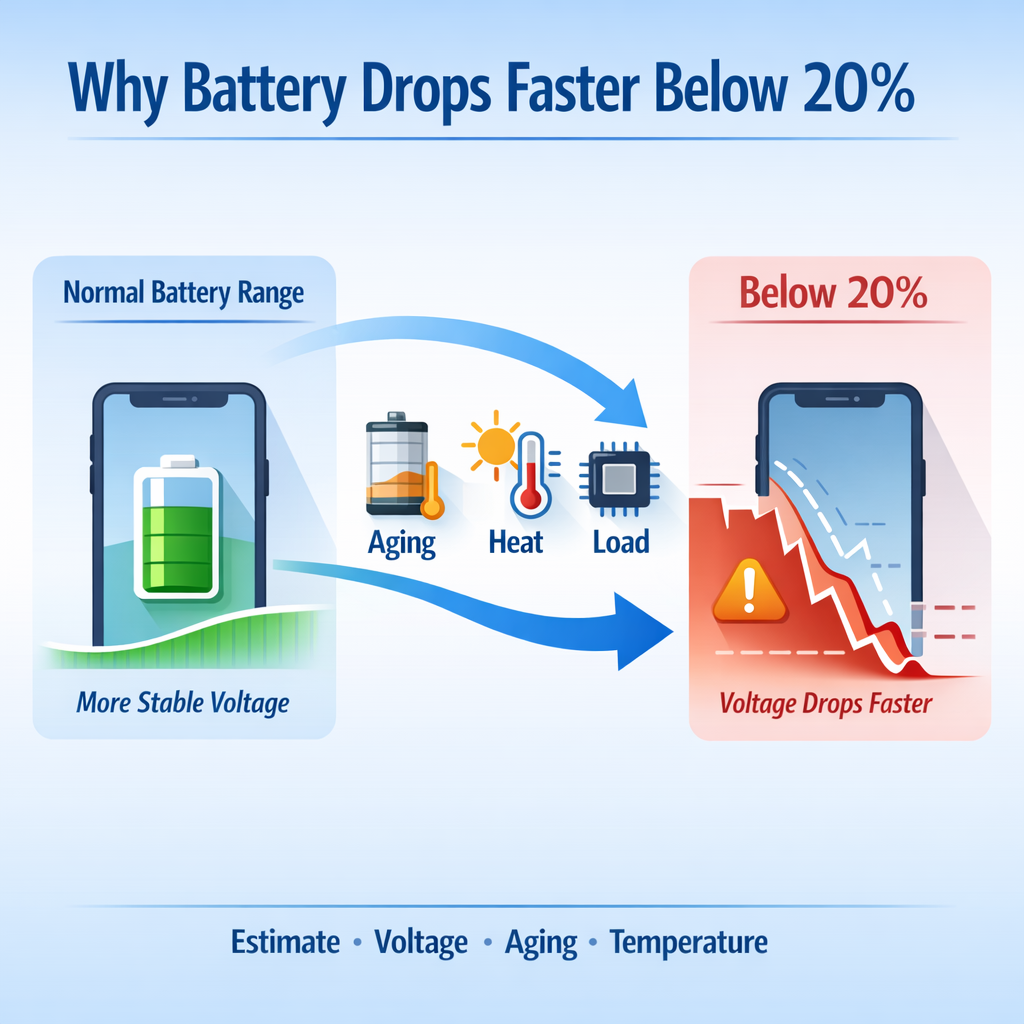
Lithium batteries do not discharge in a perfectly straight line. In the middle range, voltage is usually more stable. At lower levels, especially near the bottom end, voltage can fall more quickly under load, which makes the remaining battery look like it is shrinking faster.
Aging batteries make the low end less stable
As batteries age, internal resistance rises. That means voltage drops more sharply when the phone asks for power, and the effect becomes easier to notice at lower battery levels. This is why sudden drain often feels worse below 20% than above 50%.
Heavy usage makes the drop feel even faster
Low battery percentage is more sensitive when the phone is doing demanding tasks such as gaming, navigation, video recording, using a bright screen, or searching for weak signal. In those moments, the phone draws more power and the remaining percentage can fall faster.
Temperature and calibration also affect what users see
Temperature has a strong effect on battery behavior. In colder conditions, battery chemistry becomes less efficient and voltage can drop more sharply under load. In hotter conditions, heat can change system behavior and increase battery stress.
Battery calibration can matter too. A phone estimates battery percentage based on patterns it has learned over time. If the estimate drifts away from the real battery condition, the displayed percentage may become less smooth in certain ranges, especially near the bottom end.
Phones also keep a hidden safety margin to protect battery health and system stability. Because of that, the last part of the battery can feel shorter than many users expect, even when the system is working normally.
When it is normal, and when it may need attention
A faster drop between 20% and 10% can be normal if the phone is older, the battery has many charge cycles, the device is under heavy load, the environment is hot or cold, or battery estimation is slightly off.
It may deserve closer attention if you notice:
- the battery suddenly gets much worse in a short time
- the phone shuts down before 0%
- battery percentage jumps unpredictably
- the phone heats unusually fast
- overall battery life has clearly declined
What users can do
- Reduce heavy tasks when battery is already low.
- Avoid extreme heat and cold during use and charging.
- Keep software updated so battery management stays optimized.
- Use reliable chargers and cables.
- Check battery health if the device supports it.
- Replace the battery when aging becomes obvious.
Bottom line
When a phone battery drops faster between 20% and 10%, the reason is usually not one single defect. It is often the combined result of battery chemistry at lower charge levels, voltage drop under load, battery aging, temperature, and estimation accuracy inside the phone. The battery is not always “lying.” Sometimes it is simply showing its real limits more clearly near the bottom.
For more insights on batteries, cables, chargers, and power banks, visit our website:
https://www.janonpowerbank.com