Certification Is Becoming a Competitive Tool Rather Than Just a Compliance Requirement in Charging Products
- Share
- Issue Time
- Mar 30,2026
Summary
Certification in charging products is evolving from a basic compliance step into a strategic tool. It now helps demonstrate reliability, compatibility, and product credibility, becoming an important factor in how products compete in the market.
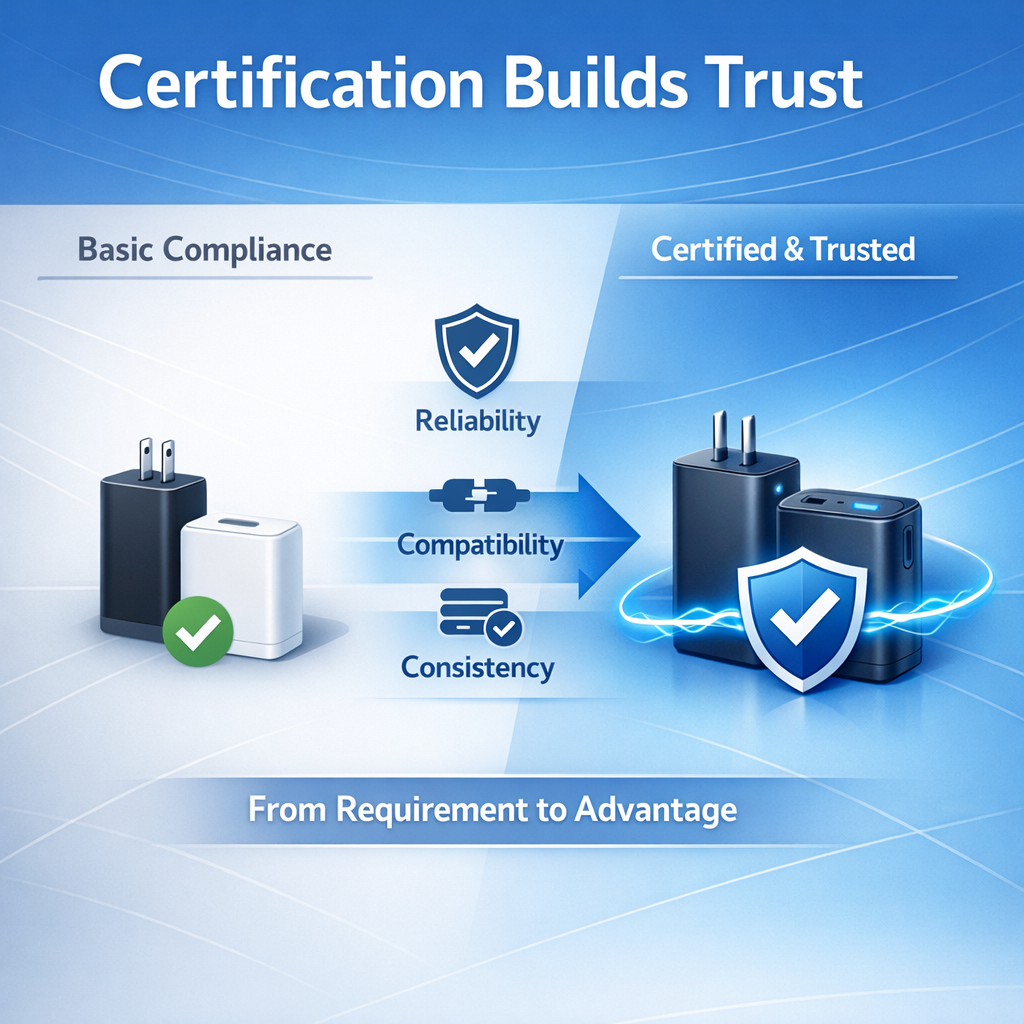
Certification Is Becoming a Competitive Tool Rather Than Just a Compliance Requirement in Charging Products
Certification in the charging industry is evolving from a basic compliance step into a visible signal of reliability, compatibility, and market credibility.
Why this shift matters
In March 2026, developments across charging standards organizations and certification systems pointed to a broader shift in how certification is being used in the charging industry. What was once treated mainly as a regulatory requirement is increasingly becoming a visible sign of product quality, compatibility, and reliability.
This change reflects the fact that charging products now compete in a more complex ecosystem, where wattage alone is no longer enough to define real performance or market trust.
How certification is changing its role
From pass-or-fail to proof of capability
Certification used to function mainly as a simple threshold. A product either passed or failed. Today, it increasingly acts as evidence that a charging product performs consistently within a broader ecosystem and supports real-world compatibility.
Reducing uncertainty for buyers
Modern charging involves protocol negotiation, device-specific behavior, and varying thermal control logic. Certification helps reduce uncertainty by showing that a product has been tested under defined conditions instead of relying only on theoretical specifications.
Supporting product positioning
For manufacturers and distributors, certification can now support product positioning in the market. It becomes part of how a brand communicates reliability, compatibility, and lower risk to customers.
Moving earlier into product strategy
Certification is gradually moving upstream in product development. It now influences component selection, design choices, and testing plans earlier in the lifecycle, rather than being treated only as a final approval step.
What is pushing this trend
The pressure comes from both regulation and the market. Regulators are focusing more on interoperability and standard consistency, while buyers and users are becoming more sensitive to unstable charging, compatibility gaps, and inconsistent product behavior.
In that environment, certification is no longer just a technical requirement. It becomes a practical way to communicate trust and reduce friction in purchasing decisions.
What this means for the charging industry
- Competition is shifting from headline specifications to verified reliability.
- Certified compatibility may become a stronger selling point than maximum wattage claims.
- Product strategy may increasingly include certification planning from the design stage.
- The market may separate more clearly between spec-driven products and system-verified products.
Bottom line
Certification in charging products is no longer just about meeting minimum requirements. It is becoming a competitive tool for demonstrating credibility, reducing uncertainty, and strengthening market positioning in a more demanding ecosystem.
For more insights on charging trends and product strategy, visit our website:
https://www.janonpowerbank.com