New EU Research Puts Battery Removability and Replaceability at the Center of Future Product Design
- Share
- Issue Time
- Mar 30,2026
Summary
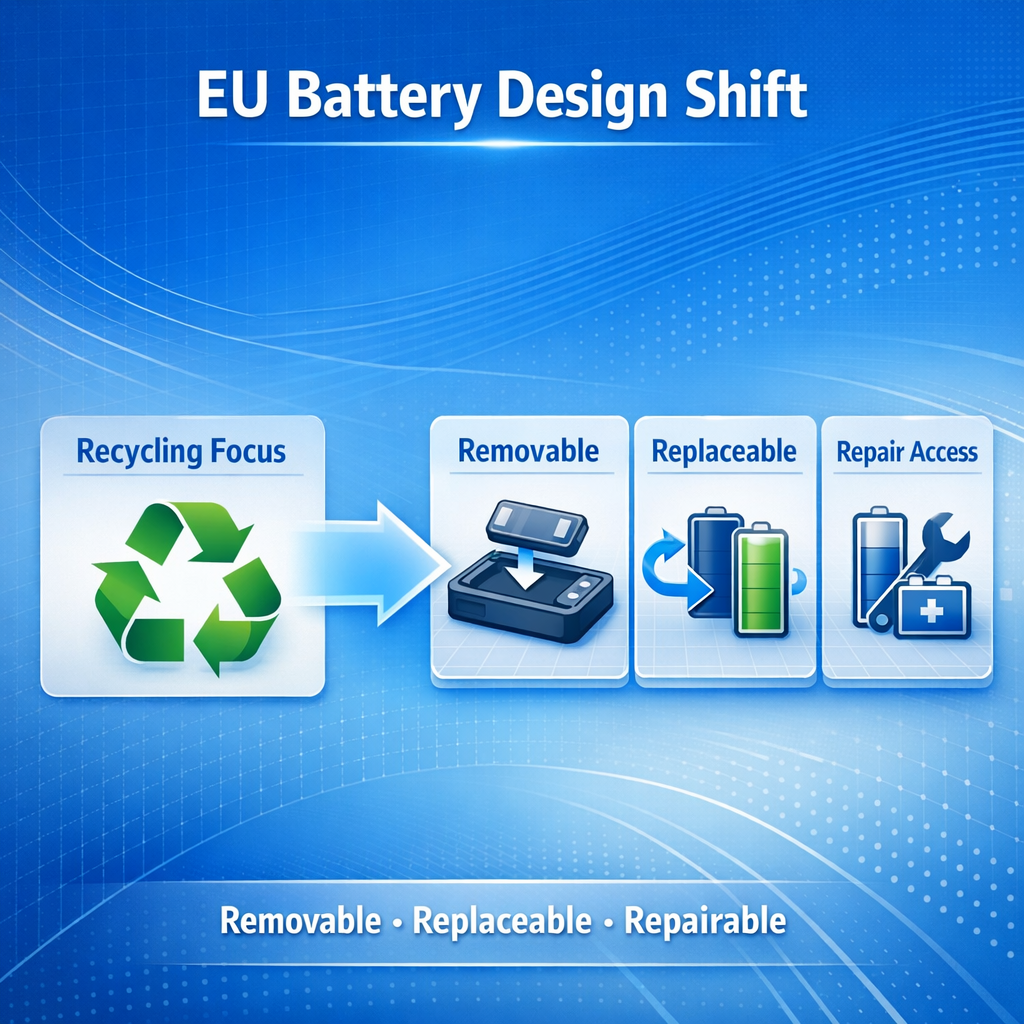
A new EU study highlights a shift in battery policy from recycling toward removability, replaceability, and repair access. The findings suggest that future competitiveness for power banks and charging products may depend not only on performance, but also on structural design and serviceability.
New EU Research Puts Battery Removability and Replaceability at the Center of Future Product Design
A new European Commission study signals that battery-related product design in Europe is moving beyond recycling alone and toward removability, replaceability, and repair access.
Why this study matters
In late March 2026, the Joint Research Centre of the European Commission released a new study highlighting a structural shift in how batteries are expected to be integrated into consumer electronic products. Instead of focusing only on recycling performance, the study places growing attention on battery removability, replaceability, and repair accessibility.
The message is simple but important: battery-related policy discussion in Europe is no longer limited to what happens at the end of a product’s life. It is increasingly concerned with how a product is designed, opened, maintained, and serviced throughout its full lifecycle.
The design direction behind the shift
According to the study, many compact electronics such as smartphones, power banks, and portable charging devices have been designed around sealed structures and slim form factors. These design choices support portability and visual appeal, but they also make battery replacement harder and can shorten the useful life of the product.
As a result, battery access is becoming a bigger policy issue. The discussion is expanding from environmental outcomes alone to the practical question of whether batteries can be removed, replaced, and serviced without damaging the device or relying on unnecessarily restrictive design methods.
Three themes now gaining weight in Europe
Products are increasingly expected to allow battery removal without causing damage to the device. This puts more attention on physical structure, fastening methods, and how accessible key internal components are during disassembly.
The ability to replace a battery safely and efficiently is being discussed as more than a convenience feature. It is increasingly tied to broader compliance and sustainability thinking, especially where product lifespan and resource use are under review.
Repair access goes beyond the battery itself. It also involves spare part availability, access to repair information, and design transparency that supports maintenance across the product lifecycle.
What this means for battery and charging product makers
For manufacturers of batteries, chargers, cables, and power banks, the study points to a broader shift in what makes a product competitive in Europe. Electrical performance and charging speed still matter, but they are no longer the only signals of quality.
Structural design decisions may play a larger role in future market acceptance. Products that consider easier disassembly, more modular layouts, and better service access may be better positioned as European policy expectations continue to evolve.
In practical terms, this means that future compliance pressure may increasingly show up not only in test reports and labels, but also in the way a product is built from the inside out.
Bottom line
This new EU research suggests that battery policy in Europe is moving beyond end-of-life recycling and toward full lifecycle design responsibility. Removability, replaceability, and repair access are becoming part of a larger conversation about how portable electronics should be designed for the future.
For more insights on battery and charging product trends, visit our website:
https://www.janonpowerbank.com