IATA Revises Passenger Guidance for Lithium Batteries, Including Power Banks
- Share
- Issue Time
- Mar 19,2026
Summary
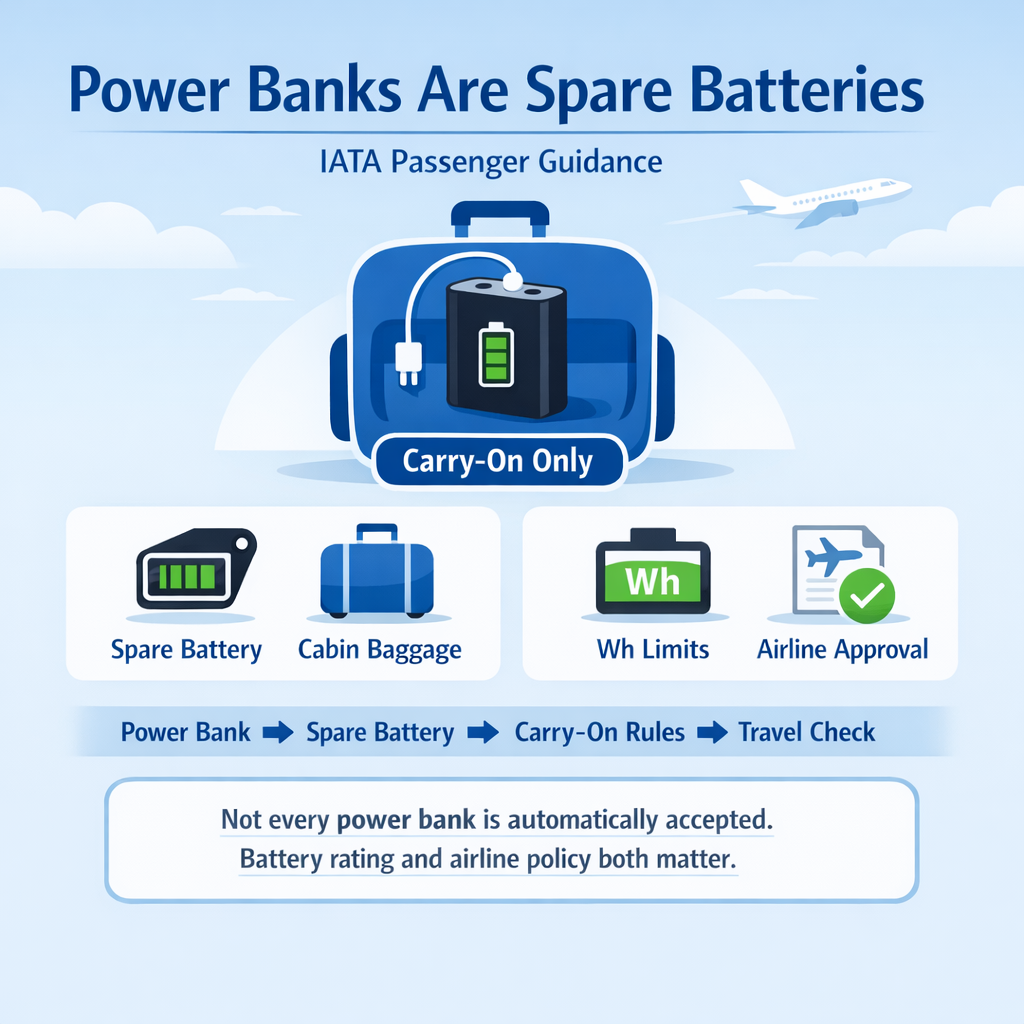
IATA’s revised passenger guidance confirms that power banks are treated as spare lithium batteries, not ordinary electronics. They must be carried in cabin baggage, remain subject to watt-hour limits and possible airline approval rules, and require more careful handling because aviation safety policies distinguish spare batteries from batteries installed in equipment.
IATA Revises Passenger Guidance for Lithium Batteries, Including Power Banks
In 2026, IATA updated its passenger guidance on travelling with lithium batteries, including rules that affect power banks, spare batteries, and battery-powered devices carried by air passengers.
The guidance is especially important for power banks because they are treated as spare lithium batteries, which places them under stricter carriage rules than many ordinary electronic devices.
Topic: Passenger guidance for lithium batteries and power banks
Core area: Carry-on rules, watt-hour thresholds, and safe carriage requirements
Why it matters: Power banks are classified as spare lithium batteries
Power Banks Must Remain in Cabin Baggage
According to IATA’s passenger guidance, spare lithium batteries, including power banks, must be carried in cabin baggage rather than checked baggage.
This rule exists because lithium battery incidents are easier to detect and manage in the cabin than in the aircraft hold.
Watt-Hour Limits Still Matter
The guidance also emphasizes watt-hour thresholds that affect whether a battery is generally permitted, restricted, or may require airline approval.
In practice, this means travelers should not assume every power bank is automatically acceptable just because it is a consumer product.
- Battery watt-hour rating
- Quantity carried by the passenger
- Whether airline approval is required
- Airline-specific operating policy
Spare Batteries and Installed Batteries Are Not Treated the Same
Another important point is that IATA distinguishes between batteries installed in equipment and spare batteries carried separately.
A power bank falls into the spare-battery category, so passengers need to pay closer attention to how it is packed, protected against short circuit, and carried during travel.
| Category | How IATA Treats It |
|---|---|
| Battery Installed in Equipment | Handled under the rules for equipment containing batteries. |
| Spare Battery | Subject to stricter cabin-carry and protection requirements. |
| Power Bank | Treated as a spare lithium battery, not as a normal electronic device. |
What Travelers Should Do Before Flying
For travelers, the practical message is simple: check the battery rating before departure, keep power banks in carry-on baggage, protect exposed terminals when necessary, and review the specific airline’s policy before flying.
Why This Matters for Power Bank Brands
For the portable power industry, the updated guidance matters because it affects product communication as well as compliance awareness.
Brands selling power banks increasingly need to make battery ratings clear, explain travel-related carrying rules, and help users understand that aviation requirements are based on lithium battery classification rather than only on product type.
- Clearly label battery rating and transport relevance
- Explain cabin-carry rules for power banks
- Educate users on spare battery classification
- Support safer travel behavior through clear product guidance
Conclusion
IATA’s revised passenger guidance makes it clear that power banks are not treated as ordinary travel electronics. They are regulated as spare lithium batteries, which means cabin-only carriage, closer attention to watt-hour limits, and more emphasis on safe handling during travel.
As power banks remain a common travel accessory, clearer guidance helps reduce confusion for travelers and supports safer battery transport in the passenger cabin.