USB-IF Releases Updated USB Power Delivery Compliance Test Specification
- Share
- Issue Time
- Mar 16,2026
Summary
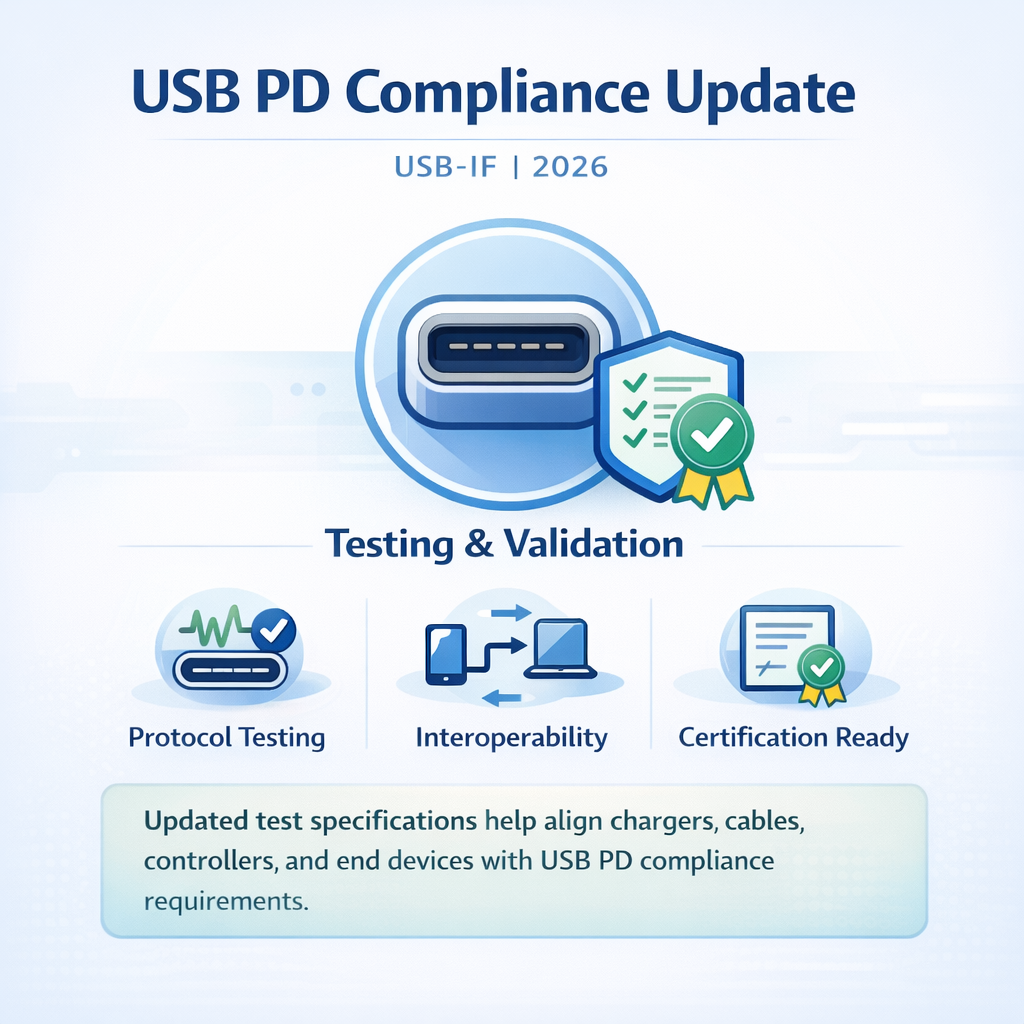
In March 2026, USB-IF released an updated USB Power Delivery Compliance Test Specification for chargers, cables, controllers, and end devices. The update strengthens the testing basis for protocol validation, interoperability, and certification readiness across the USB-C fast-charging ecosystem.
USB-IF Releases Updated USB Power Delivery Compliance Test Specification
In March 2026, USB-IF published an updated USB Power Delivery Compliance Test Specification, providing the latest test framework used to verify whether USB PD products meet official compliance requirements.
The update is relevant to chargers, cables, controllers, and end devices that rely on USB Power Delivery for fast charging and power negotiation.
Organization: USB Implementers Forum (USB-IF)
Scope: Chargers, cables, controllers, and end devices
Core relevance: Protocol validation, interoperability, and certification readiness
Why the Updated Specification Matters
USB Power Delivery products are expected to behave consistently across different brands and device categories. A formal compliance test specification helps manufacturers validate whether a product correctly handles power negotiation, voltage and current behavior, protocol messaging, and other technical conditions required by USB PD certification.
What the Update Can Influence in Practice
Updated compliance specifications can affect more than certification paperwork. In real development and testing workflows, they may influence how companies validate firmware behavior, how test laboratories structure procedures, and how products are tuned for more stable fast charging performance.
| Area | Practical Impact |
|---|---|
| Product Validation | Manufacturers may need to update internal validation flows to match the newest test basis. |
| Test Lab Procedures | Labs may align their compliance checks with the latest published USB PD specification. |
| Firmware Tuning | Protocol behavior and power negotiation logic may require refinement. |
| Interoperability Performance | More standardized testing can improve charging consistency across product categories. |
Why This Matters for Chargers, Cables, and Portable Power Products
For companies involved in chargers, mobile accessories, and portable power products, the new specification is a reminder that USB PD performance is not only about headline wattage. Correct protocol implementation, stable negotiation behavior, and compliance-tested design all influence whether a product performs properly in the market.
- USB-C chargers and adapters
- Fast charging cables and active cable designs
- Power banks supporting USB Power Delivery
- End devices that rely on accurate USB PD negotiation
A Stronger Testing Basis for the USB-C Ecosystem
As USB-C charging becomes more deeply integrated across smartphones, laptops, power banks, and accessories, compliance consistency remains critical for user safety and real-world charging reliability. Updates like this help strengthen ecosystem compatibility as more brands adopt USB-C and USB Power Delivery across product lines.
The latest specification supports a more standardized testing basis for the fast-charging products that increasingly define modern consumer electronics.