EU Publishes Official Guidelines on Removable and Replaceable Portable Batteries Under Battery Regulation (EU) 2023/1542
- Share
- Issue Time
- Jan 26,2026
Summary
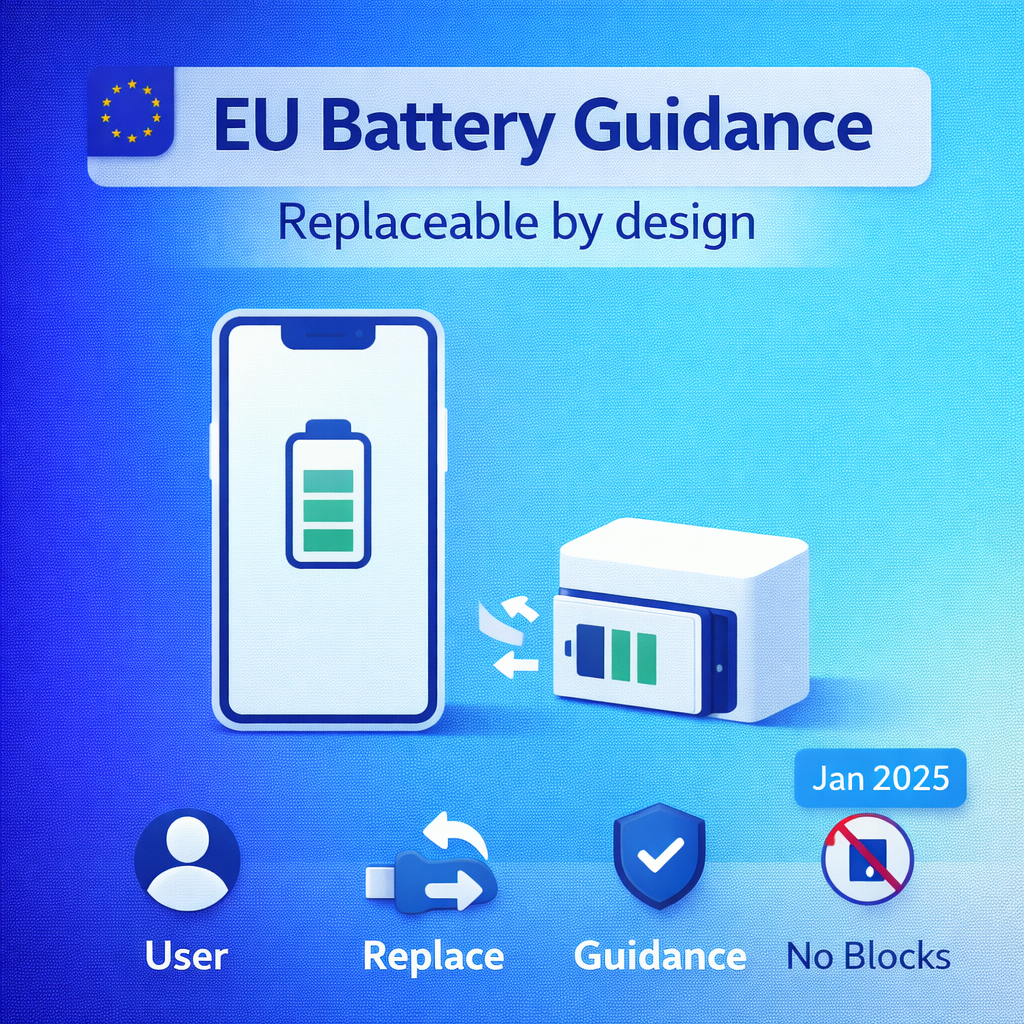
In January 2025, the EU Official Journal published the European Commission’s guidance (C/2025/214) on how to apply Battery Regulation (EU) 2023/1542, Article 11, covering portable battery removability and replaceability. The document clarifies what “end-user replaceable” means in practice, when limited derogations may apply, and emphasizes that software should not create barriers to battery replacement.
Industry News
EU Publishes Official Guidelines on Removable and Replaceable Portable Batteries Under Battery Regulation (EU) 2023/1542
On 10 January 2025, the Official Journal of the European Union published European Commission guidelines (Commission Notice C/2025/214) to support a harmonised application of the rules on removability and replaceability of portable batteries under Regulation (EU) 2023/1542.
What Was Published
Commission Notice C/2025/214: practical guidance for applying Article 11 on portable battery removability and replaceability.
Why It Matters
The guidance sharpens the practical interpretation of end-user replaceability and the boundary conditions for limited derogations.
Practical Interpretation of Article 11
The guidance is intended to clarify how "removable and replaceable by the end-user" should be understood in practice, including how product design choices relate to the legal expectation. It reinforces a general principle of end-user removability and replaceability, while outlining that limited derogations may be argued where safety, continued safe use, or data integrity risks can be demonstrated with credible justification.
Compliance Signal
The EU is emphasising a practical, user-facing route to battery replacement, and it expects any exception claims to be evidence-based rather than broad marketing statements.
Software Should Not Create Repair Friction
A notable section addresses software-related barriers. The guidance indicates that software notifications can inform users when a non-original spare battery is in use, but such notifications should not affect device functionality, compatible battery functionality, or overall user experience. The broader direction is that software measures should not impede repair and replacement in practice.
How This Connects to the 2025 Smartphone Regulatory Package
The publication also aligns with the broader 2025 regulatory environment for smartphones. From 20 June 2025, related EU rules for phones include obligations connected to serviceability, including access to batteries and, where needed, certain fasteners for professional repairers and end users. This reinforces the market direction toward practical repairability as a baseline expectation.
| Topic | What The Guidance Highlights | Why It Is Watched |
|---|---|---|
| End-user replaceability | Clearer practical interpretation under Article 11 | Design and market claims must align with real replacement pathways |
| Limited derogations | Exceptions framed around safety, safe use, and data integrity risks | Higher scrutiny on evidence-based justifications |
| Software barriers | Notifications allowed, but no functionality or experience degradation | Repair must not be blocked by software friction |
Overall, the January 2025 publication does not change the underlying law, but it can materially shape compliance expectations by clarifying how companies should justify design choices and how replacement pathways should work in practice when placing battery-containing products on the EU market.
For power accessories built around stable real-world compatibility, visit