How Small Mini Power Banks Deliver Big Performance — Inside the Boost Converter
- Share
- Issue Time
- Dec 4,2025
Summary
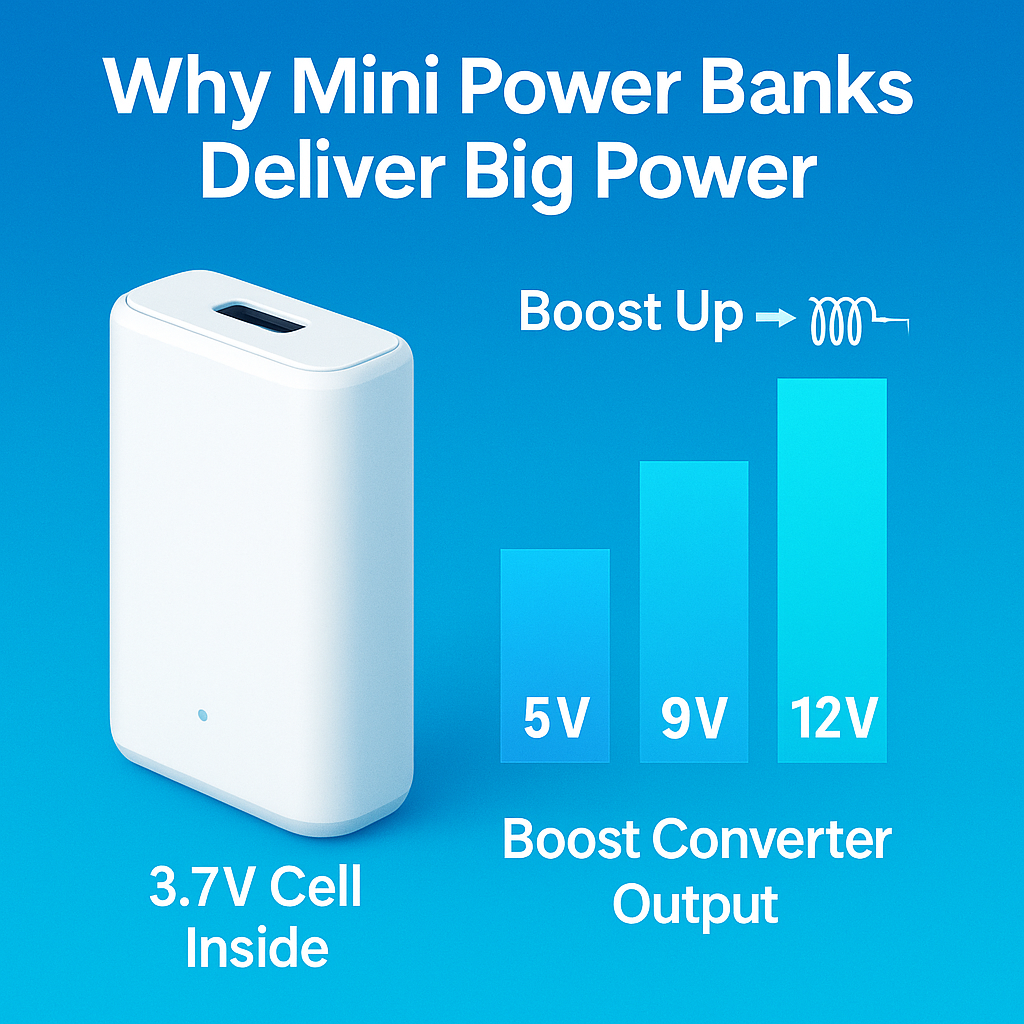
Mini power banks deliver strong charging performance because their boost converters turn a 3.7V internal cell into stable 5V–12V output. Efficiency, heat control, and protocol chips determine real-world quality.
How Small Mini Power Banks Deliver Big Performance — Inside the Boost Converter
Mini power banks look tiny but can charge phones almost as quickly as bigger models. The secret is a compact boost converter that turns low battery voltage into stable output power.
Quick view
- Why mini power banks use 3.7V cells
- How boost converters raise voltage
- What makes a safe high-efficiency design
Mini power banks have become some of the most popular charging gadgets in recent years. They are small enough to slip into a pocket, yet powerful enough to deliver charging speeds close to larger power banks. Many users wonder how such a tiny device can output 5 V or even fast-charging voltage when the internal battery cell is only 3.7 V.
The answer is the boost converter, a compact and efficient power-conversion system that transforms low battery voltage into stable output power for smartphones.
1. Why mini power banks start at 3.7 V
All lithium-ion cells, including the ones inside mini power banks, operate at around 3.7 V nominal voltage. This voltage is ideal for energy density and safety inside compact enclosures, but it is not high enough to charge a smartphone, which usually expects 5 V, 9 V, or 12 V depending on the charging protocol. Without voltage boosting, the phone would not recognize the mini power bank as a valid charger.
2. How the boost converter takes 3.7 V to 5 V
The boost converter works like a tiny step-up engine. Inside the circuit, an inductor stores magnetic energy, a switching MOSFET rapidly turns the current path on and off, and a diode plus capacitor smooth out the output. A control chip monitors the output and constantly adjusts switching frequency to maintain stable voltage.
3. How mini power banks support fast charging
Some mini power banks support USB-C fast charging such as 9 V at 2 A or 12 V at 1.5 A. To handle this, the design must use a higher-efficiency boost circuit, include protocol chips that understand PD or QC signalling, and keep the PCB layout short and clean for lower resistance. When these conditions are met, a mini power bank can deliver performance similar to a 5000–10000 mAh model while staying much more compact.
Fast charging checklist
- Efficient boost converter IC
- PD / QC compatible protocol chip
- Good thermal path and copper area
- Low-resistance USB-C connector
4. Why conversion efficiency matters
Boost converters are never one hundred percent efficient. Typical efficiency is about 85 percent for very small mini power banks and around 90 to 92 percent for larger premium models. The difference becomes visible in how long they can keep your phone charging and how hot they feel during use.
5. Are mini power banks safe
High-quality mini power banks use stable boost chips, proper thermal pads, and multiple layers of protection, including short-circuit, over-voltage, and over-current protection. Certified USB-C ports and tested housings keep temperatures under control, even during fast charging.
Cheap unbranded models may skip these protections. The result can be overheating, unstable output, and faster wear on the phone battery. Treat mini power banks as serious power devices, not simple toys.
6. Why mini power banks are becoming more popular
Mini power banks are ideal for short trips, commuting, and evenings out. They are extremely portable, fit easily into a small bag or pocket, and can still provide enough energy to keep a modern phone alive through the key part of the day. Many users prefer a light mini model for daily carry and keep a larger power bank at home or in the office.
Conclusion
Mini power banks deliver surprising performance thanks to efficient boost converter technology and modern USB-C fast-charging protocols. When choosing one, look for stable voltage output, good heat control, and proper safety certifications to protect both your phone and its battery over time.
A well-designed mini power bank can be one of the most useful accessories you carry every day, combining convenience, safety, and real-world performance in a pocket-sized body.
Explore reliable mini power banks, USB-C chargers, and smartphone batteries designed for real safety and performance at