Why a Bigger Power Bank Does Not Always Mean Better Charging Experience
- Share
- Issue Time
- Mar 16,2026
Summary
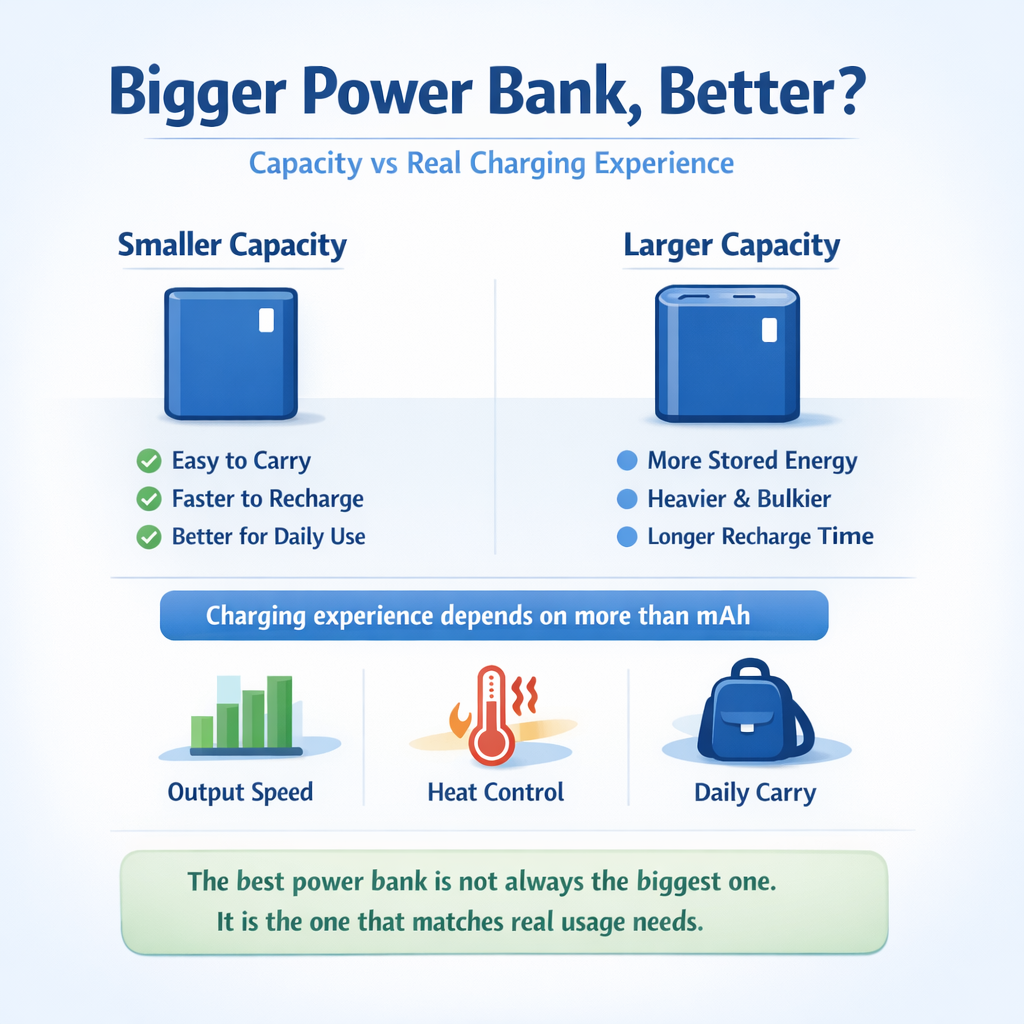
A bigger power bank does not always mean a better charging experience. While higher capacity offers more stored energy, real-world usability also depends on portability, output speed, charging efficiency, heat control, recharge time, and compatibility with your devices.
Why a Bigger Power Bank Does Not Always Mean Better Charging Experience
Many buyers assume that a larger-capacity power bank automatically delivers a better charging experience. On paper, this sounds logical: more capacity should mean more charging cycles, longer backup time, and fewer worries about running out of power.
But in real use, a bigger power bank does not always feel better. In some cases, it may even feel less convenient than a smaller one. That is because charging experience depends on more than capacity alone.
Capacity Is Only One Part of the Experience
Power bank capacity, usually shown in mAh, tells users how much energy the internal battery cells can store. A higher number matters for longer trips or multiple-device charging, but daily usability depends on several other factors.
Bigger Capacity Usually Means Bigger Size and Weight
To increase capacity, manufacturers usually need more cells or larger cells inside the power bank. That often means more weight, thicker housing, and larger dimensions.
A compact 10000mAh model may be easy to carry every day, while a 20000mAh or higher model may feel bulky in a pocket and inconvenient for casual commuting.
- Higher capacity often means more weight
- Larger housing reduces pocket convenience
- Bulky products may be used less often in daily life
Output Performance Matters More Than Raw Capacity
A large-capacity power bank is not automatically a fast one. Charging experience depends heavily on output design, including supported protocols, maximum wattage, voltage stability, current control, and port power distribution.
| Factor | Why It Affects Experience |
|---|---|
| Fast Charging Protocols | Better protocol support can improve compatibility and charging speed |
| Maximum Output Wattage | Higher usable output can make charging feel much faster |
| Voltage and Current Stability | Stable delivery improves real-world charging consistency |
| Port Design | Better port distribution supports more useful multi-device charging |
Real Usable Energy Is Lower Than Rated Capacity
Rated mAh is not the same as fully usable output. Power banks store energy at battery-cell voltage, but phones charge at a different voltage. Energy must be converted, and some of it is lost as heat and circuit inefficiency.
This means a larger power bank still loses part of its stored energy during output, and actual charging results depend on conversion efficiency as much as capacity.
Heat and Charging Stability Affect Comfort
Bigger power banks may operate under heavier internal thermal load, especially when charging multiple devices or delivering high-power output for extended periods. If thermal design is not strong enough, users may notice more surface heat, slower charging after temperature rises, or reduced stability under load.
A smaller, better-optimized model may feel cooler and more stable, even if its capacity is lower.
Recharge Time of the Power Bank Matters Too
A large-capacity power bank also takes longer to recharge. This is an important but often overlooked part of user experience.
A higher-capacity model may provide more total output time, but it may also require much more time to refill, especially if input wattage is limited or the product does not support fast input charging.
- Long recharge times reduce convenience for daily users
- Commuters may prefer smaller models that refill faster
- Input charging speed is part of the overall experience
Different Use Cases Need Different Capacities
The best charging experience depends on how the power bank is used. Smaller models can be better for commuting, pocket carrying, emergency top-ups, and lightweight travel. Larger models are often better for long-distance travel, multi-device charging, business trips, and outdoor use without easy access to power.
| Smaller Power Bank | Larger Power Bank |
|---|---|
| Daily commuting | Long-distance travel |
| Pocket carrying | Multiple-device charging |
| Emergency top-ups | Business trips |
| Lightweight travel | Outdoor use without easy access to power |
How to Choose Beyond Capacity
When comparing power banks, users should look beyond the mAh number. Important factors include real output wattage, charging protocol support, efficiency, thermal design, input charging speed, size, portability, and the number and type of ports.
- Real output wattage
- Fast charging protocol support
- Efficiency and thermal design
- Input recharge speed
- Size and portability
- Port quantity and type
Conclusion
A bigger power bank does not always mean a better charging experience because capacity is only one part of performance. Portability, output speed, efficiency, heat control, recharge time, and compatibility all influence how useful a power bank feels in everyday life.
Choosing the right power bank is not about chasing the biggest number. It is about matching capacity and design to real usage needs.