Why Your Phone Charges Fast to 50% Then Slows Down
- Share
- Issue Time
- Jan 7,2026
Summary
Phones charge quickly to around 50% because they can safely accept higher current at low battery levels, then slow down as they approach 80% to 100% to reduce heat and protect long-term battery health. This article explains the charging curve and the key factors that make the slowdown more noticeable, including temperature, cable quality, and battery age.
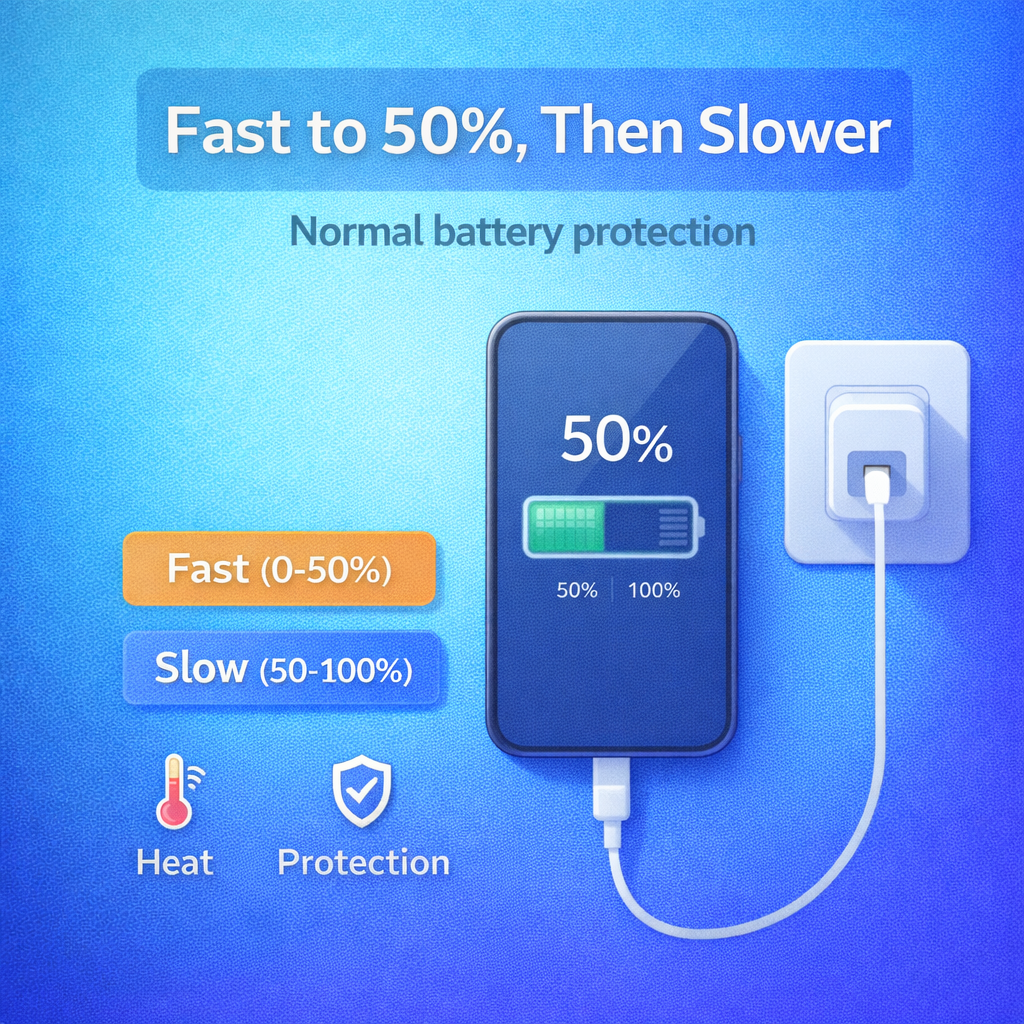
Why Your Phone Charges Fast to 50% Then Slows Down
If your phone seems to fly from 0% to around 50% and then suddenly slows down, your charger usually is not failing. This behavior is built into how lithium-ion batteries are charged safely. The goal is speed early, and protection later.
What You See
Fast to about 50%, then a noticeable slowdown toward 80% and 100%.
Why It Happens
Your phone limits power on purpose to control heat and reduce battery stress at higher charge levels.
Phones Do Not Charge At One Constant Speed
Charging is controlled by your phone, not just the charger. The phone decides how much power to accept based on battery voltage, temperature, and long-term battery health. So the curve is intentional, not random.
The Two-Phase Pattern Explains Most Slowdowns
Most phones follow a pattern that feels like two phases: the early stage is fast because the battery can accept higher current at low charge, and the later stage is slower because the phone reduces current as it approaches a higher state of charge. This helps control heat and long-term wear.
| Charging Stage | What It Feels Like | What The Phone Is Doing |
|---|---|---|
| Low to mid level | Fast, noticeable gains | Accepts higher current more easily |
| Mid to high level | Gradual slowdown | Reduces current to limit stress and heat |
| Near full | Slowest part | Tapers power to protect the battery at high charge |
Heat Is The Biggest Reason Slowdowns Become Dramatic
Heat makes the phone protect the battery more aggressively. Fast charging while using heavy apps, charging in a hot environment, thick cases that trap heat, and poor cables that create extra resistance can all raise temperature and trigger throttling.
Simple Signal
If charging speed changes noticeably with temperature or heavy usage, heat throttling is usually the reason.
Cable And Port Bottlenecks Can Trigger A Safer Mode
A weak cable or loose connector may still look fine at the beginning, but become unstable at higher power or higher temperature. Then the phone drops to a safer mode. If speed changes when you touch the cable, the cable or connector is often the culprit.
Battery Age Changes The Curve
As a battery ages, internal resistance rises. That means more heat at the same power level, so the phone throttles earlier. This is why older phones often slow down sooner than newer ones, even with the same charger.
What You Can Do For Faster, More Stable Charging
Use a solid USB-C cable that matches your charger’s power level, keep the phone cool while charging, avoid hot environments, and consider charging to 80% when you need speed. A fast charge to 50% is normal, and the slowdown is your phone being careful, not your phone being broken.
For stable charging solutions and daily-use power accessories, visit