Why Your 10000mAh Power Bank Never Feels Like 10000mAh — The Real Reason Will Surprise You
- Share
- Issue Time
- Nov 28,2025
Summary
A 10000mAh power bank rarely delivers its full capacity because of voltage conversion loss, heat, cable resistance, and phone protection, leaving only 5000–6500mAh usable.
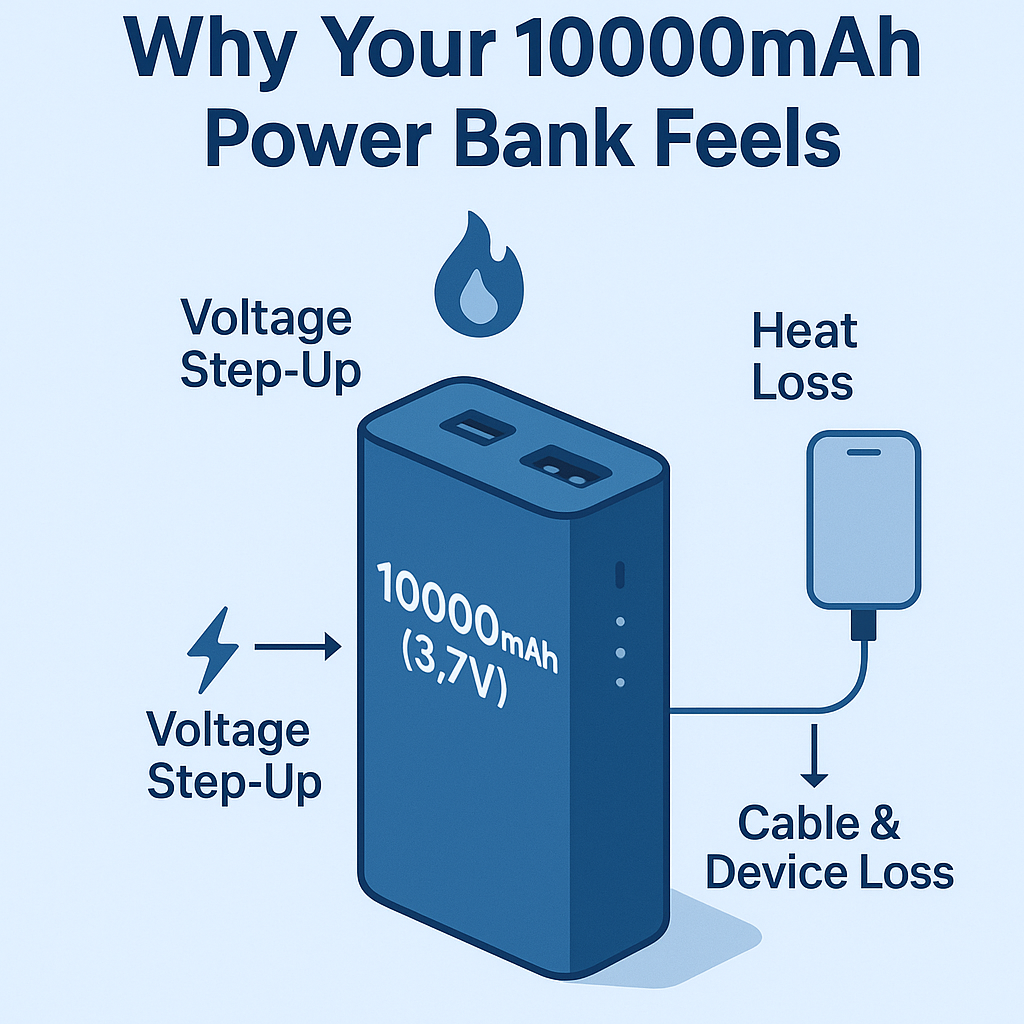
If your 10000mAh power bank feels more like a 6000mAh one, you are not imagining it. Many users believe their power bank is underperforming or even fake, but in reality the science behind power conversion, heat, and battery protection explains why a 10000mAh unit never delivers the full number printed on the packaging.
This article breaks down where the missing energy goes in a simple and transparent way, so you can better understand power bank capacity and make smarter buying decisions.
1. Why a 10000mAh power bank cannot deliver 10000mAh to your phone
The most common misunderstanding comes from how mAh is measured. Power banks store energy in cells rated at about 3.7 V, but smartphones usually charge at 5 V, 9 V, or 12 V. This means the power bank must boost the voltage from 3.7 V up to the charging voltage through a DC-DC converter, and that process is never 100 percent efficient.
Step 1: Convert mAh to Wh, the real stored energy
A 10000mAh power bank really says that the internal cells can store about 10000mAh at 3.7 V. The more accurate way to see energy is to convert this to watt-hours, or Wh.
| Parameter | Formula | Result |
|---|---|---|
| Stored energy inside cells | 10000mAh × 3.7V | 37000mWh = 37Wh |
This 37Wh is the real internal energy stored inside the power bank cells when fully charged.
Step 2: Convert Wh back to mAh at the phone charging voltage
Now imagine your phone is charging at 5 V. If there were no conversion losses at all, the maximum energy the phone could see would be the same 37Wh, but now at 5 V instead of 3.7 V.
| Stage | Calculation | Theoretical result |
|---|---|---|
| Convert 37Wh to mAh at 5 V | 37Wh ÷ 5V | ≈ 7400mAh |
So even in a perfect situation with zero losses, your 10000mAh power bank would look more like 7400mAh at 5 V simply because the voltage is different.
Step 3: Apply real world efficiency
Real circuits are never perfect. The DC-DC boost converter that raises 3.7 V to 5 V or higher has its own efficiency rating. A good power bank may reach around 85 percent efficiency, an average model around 75 to 80 percent, and a poor quality power bank may only reach 70 percent or less.
| Power bank type | Efficiency | Usable output from 7400mAh |
|---|---|---|
| High quality 10000mAh power bank | 85% | ≈ 6300mAh |
| Average quality 10000mAh power bank | 75% | ≈ 5550mAh |
| Low quality 10000mAh power bank | 70% | ≈ 5180mAh |
On top of this, most power banks do not discharge their cells to 0 percent. A safety margin is reserved to protect the battery from deep discharge, which removes even more energy from the usable pool. The end result is that a 10000mAh power bank usually delivers around 5000 to 6500mAh of real output to your phone under typical use.
This means that a 10000mAh power bank that charges your modern smartphone about 1.2 to 1.8 times is actually behaving normally and is not necessarily fake or defective.
2. How heat quietly steals even more energy
Every time energy is converted, a part of it becomes heat. If the power bank uses low quality components, narrow traces, or weak cells, it will generate more heat during use. That heat is just lost power that never reaches your smartphone battery.
High quality power banks use efficient DC-DC converters, better battery cells, and improved layouts to reduce internal resistance. These factors help keep temperatures lower, which increases real usable capacity and improves both power bank and smartphone battery lifespan.
3. Cable quality and charging protocol also affect efficiency
Even if a 10000mAh power bank is well designed, a poor cable can ruin the experience. Thin copper wires, weak shielding, and loose connectors cause voltage drop and unstable charging. The power bank has to work harder to compensate, which increases heat and reduces efficiency.
Charging protocols make a difference as well. USB-C PD and PPS are designed to optimize voltage and current for efficiency and stability. Older or basic 5 V charging modes tend to waste more energy, especially with larger battery capacities. Pairing a good USB-C PD power bank with a decent cable and compatible smartphone can noticeably improve real world performance.
4. Your smartphone also consumes part of the energy through protection behavior
Your smartphone is not a passive device. Its battery management system constantly watches temperature, voltage, and charge level. It may slow down charging above 80 percent, limit current when the phone is hot, or adjust power flow during gaming, navigation, or 5G use. All of these protections are good for long term battery health but reduce the apparent usefulness of your power bank.
This means your 10000mAh power bank might feel weaker on a hot day or during heavy use because your phone is deliberately limiting how fast and how efficiently it accepts power in order to stay safe.
5. How to choose a 10000mAh power bank that performs well in real life
Since printed mAh does not tell the whole story, it is better to focus on the engineering behind the power bank. A well designed 10000mAh power bank can easily outperform a poorly built 20000mAh model. Look for the following points when choosing your next device.
Look for brands that mention conversion efficiency above 85 percent and use stable DC-DC converters.
High grade lithium polymer cells hold capacity longer and run cooler during fast charging.
USB-C ports with PD or PPS support improve efficiency and stability compared to basic 5 V output.
In addition, using good quality USB-C cables, avoiding very cheap or unbranded power banks, and watching for excessive heat during use can help you get closer to the real potential of a 10000mAh power bank.
Related search terms: 10000mAh power bank, real usable capacity, power bank efficiency, DC-DC boost converter, USB-C PD power bank, smartphone battery charging.
Conclusion
Your 10000mAh power bank is not necessarily dishonest. It is simply limited by physics, voltage conversion, heat, cable resistance, and the way your smartphone protects its own battery. Once you understand where the missing energy goes, it becomes easier to choose better designed power banks and match them with the right cables and chargers.
In the end, engineering quality matters more than printed numbers. A well built 10000mAh power bank can deliver stable, efficient power and provide a much better real world experience than a cheaply made device with a larger label.
Explore high efficiency power banks, reliable smartphone batteries, and USB-C PD fast chargers designed for real world performance at www.janonpowerbank.com .