Why Some Power Banks Lose Half Their Capacity in Real Use
- Share
- Issue Time
- Mar 5,2026
Summary
This article explains why the real usable capacity of a power bank is often lower than its labeled capacity. Factors such as voltage conversion, circuit efficiency, cable resistance, and heat loss all reduce the energy that can actually be delivered to a smartphone during charging.
Why Some Power Banks Lose Half Their Capacity in Real Use
Power banks have become an essential accessory for smartphones, tablets, and portable electronics. Yet many users notice something confusing after using one: a power bank labeled 10000mAh often charges a phone only two or three times.
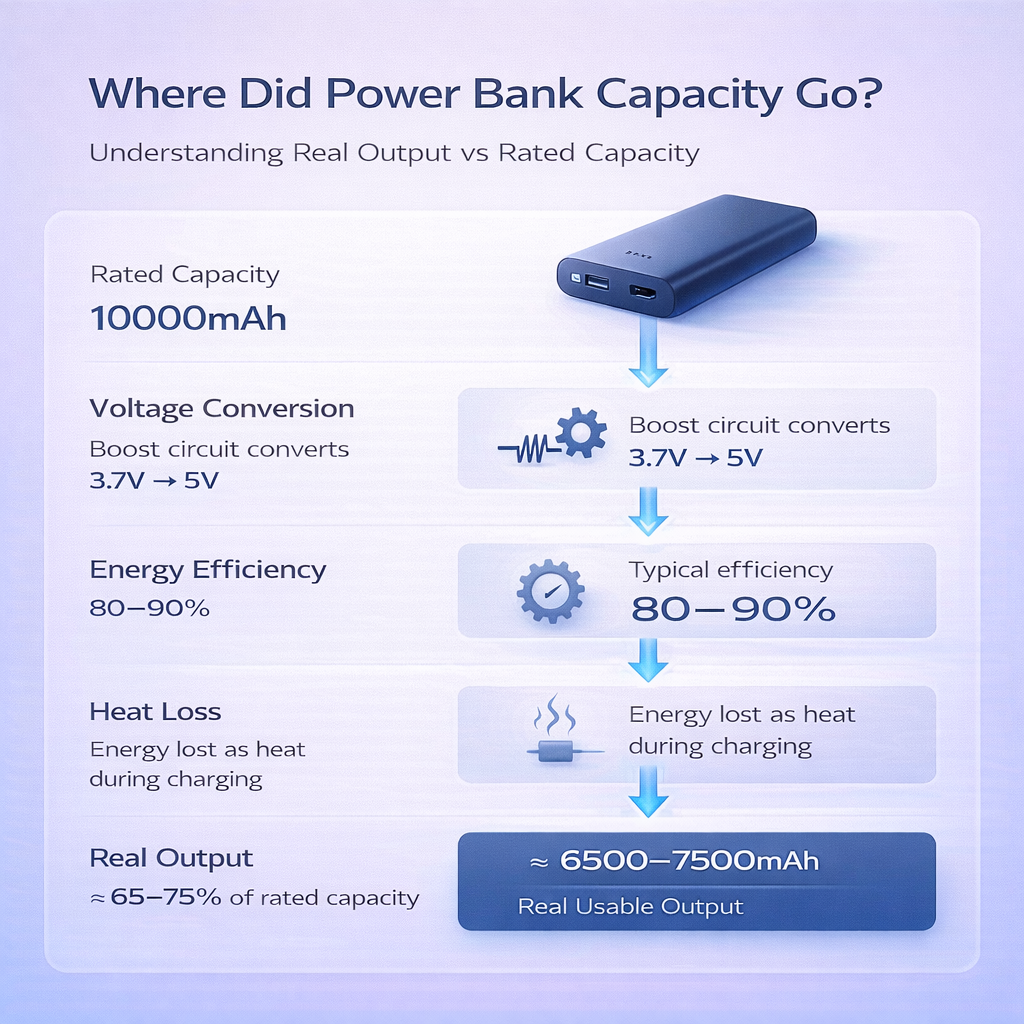
This leads to a common question: where did the rest of the capacity go? The answer involves voltage conversion, energy efficiency, and heat loss.
The capacity printed on a power bank refers to the battery cells inside the device, not the exact energy delivered to your phone.
Battery Capacity vs Output Capacity
A power bank labeled 10000mAh refers to the capacity of its internal lithium battery cells. These cells normally operate at about 3.7V.
Smartphones, however, typically charge at 5V or higher. Because of this difference, the power bank must convert its internal voltage to the required output voltage.
≈ 3.7V lithium battery cells
5V or higher for fast charging
Energy Conversion Loss
Inside every power bank is a boost converter that raises voltage from the battery level to the USB output level. No electronic conversion process is perfectly efficient.
Most power banks operate with a conversion efficiency between 80% and 90%. The remaining energy is lost during the conversion process.
| Rated Capacity | Battery Voltage | Stored Energy | Approx Usable Output |
|---|---|---|---|
| 10000mAh | 3.7V | ≈37Wh | 6500–7500mAh |
| 20000mAh | 3.7V | ≈74Wh | 13000–15000mAh |
Cable and Heat Loss
Energy loss also occurs through charging cables and heat generated inside the circuitry. Poor quality cables with thin conductors can increase resistance and reduce efficiency.
Heat produced during the charging process also consumes energy that would otherwise be delivered to the device.
Improve charging efficiency
Better cooling reduces energy loss
Fast Charging Efficiency
Fast charging technologies such as PD (Power Delivery) and PPS increase charging speed by raising voltage and current levels. While this dramatically reduces charging time, higher power levels can slightly reduce efficiency due to increased heat.
In practice, fast charging is designed to prioritize convenience and speed rather than absolute energy efficiency.
How to Choose a Better Power Bank
A well designed power bank can deliver significantly higher usable capacity even with the same nominal rating.
- High efficiency power management chips
- Quality lithium battery cells
- Stable voltage regulation
- Efficient thermal design
- Reliable charging cables
The apparent loss of capacity in power banks is mainly caused by voltage conversion, circuit efficiency, cable resistance, and heat generation. Understanding these factors explains why a 10000mAh power bank does not always deliver the same amount of usable output capacity.
Learn more about reliable charging accessories and portable power solutions at:
https://www.janonpowerbank.com