Why Some Power Banks Charge Phones Faster Than Wall Chargers
- Share
- Issue Time
- Mar 10,2026
Summary
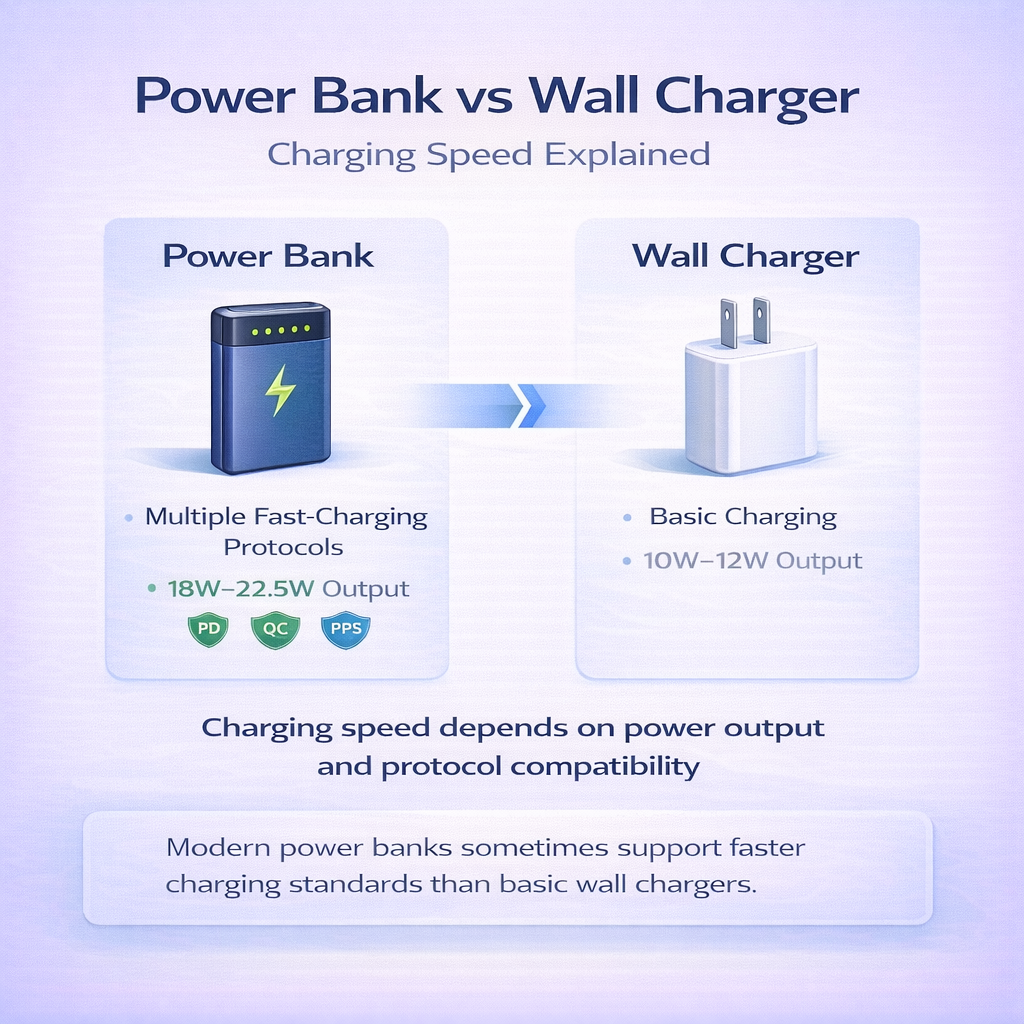
Some power banks can charge smartphones faster than wall chargers because charging speed depends on power output, protocol compatibility, and device communication. Modern power banks often support multiple fast-charging standards and higher output levels, allowing them to deliver faster charging than basic wall chargers in certain situations.
Why Some Power Banks Charge Phones Faster Than Wall Chargers
Many people assume that wall chargers are always faster than power banks. However, some users notice that their smartphone sometimes charges faster with a power bank. This surprising behavior can occur because charging speed depends on power output, charging protocol compatibility, and device communication.
Charging speed is determined by power output, charging protocol compatibility, and the communication between the charger, cable, and smartphone.
Power Output Determines Charging Speed
Charging speed is primarily controlled by power output, which is measured in watts. The higher the supported power level, the faster a device can charge, provided that the phone supports the same charging standard.
10W – 12W output
Basic charging speed
Limited fast charging support
18W – 22.5W output
Fast charging protocols
Higher power capability
Charging Protocol Compatibility
Modern smartphones rely on charging protocols to negotiate voltage and current with a power source. If a charger does not support the phone’s protocol, the charging system may limit the power level.
- USB Power Delivery (PD)
- PPS (Programmable Power Supply)
- Qualcomm Quick Charge
- Brand-specific charging systems
Many modern power banks support multiple protocols, which can improve compatibility with different devices.
The Role of Cable and Device Communication
Charging speed is determined by communication between three components: the charger or power bank, the charging cable, and the smartphone. These components exchange information to determine safe voltage and current levels.
| Component | Role in Charging |
|---|---|
| Power Source | Provides voltage and current for charging |
| Charging Cable | Transfers power and communication signals |
| Smartphone | Controls charging limits and safety management |
Advanced Power Management in Modern Power Banks
Many new power banks include advanced power management systems designed to support fast charging for smartphones and other portable devices.
Manage voltage and current dynamically
Support different fast charging standards
Maintain stable charging temperature
Conclusion
Although wall chargers are typically expected to be faster, real charging performance depends on power output, protocol compatibility, and system stability. In certain situations, a modern fast-charging power bank may deliver faster charging than a basic wall charger.
Understanding how charging technology works can help users select the right charging accessories for reliable performance.