Why 20W Feels Slower Than 18W: Fast-Charge Negotiation in Plain English
- Share
- Issue Time
- Jan 23,2026
Summary
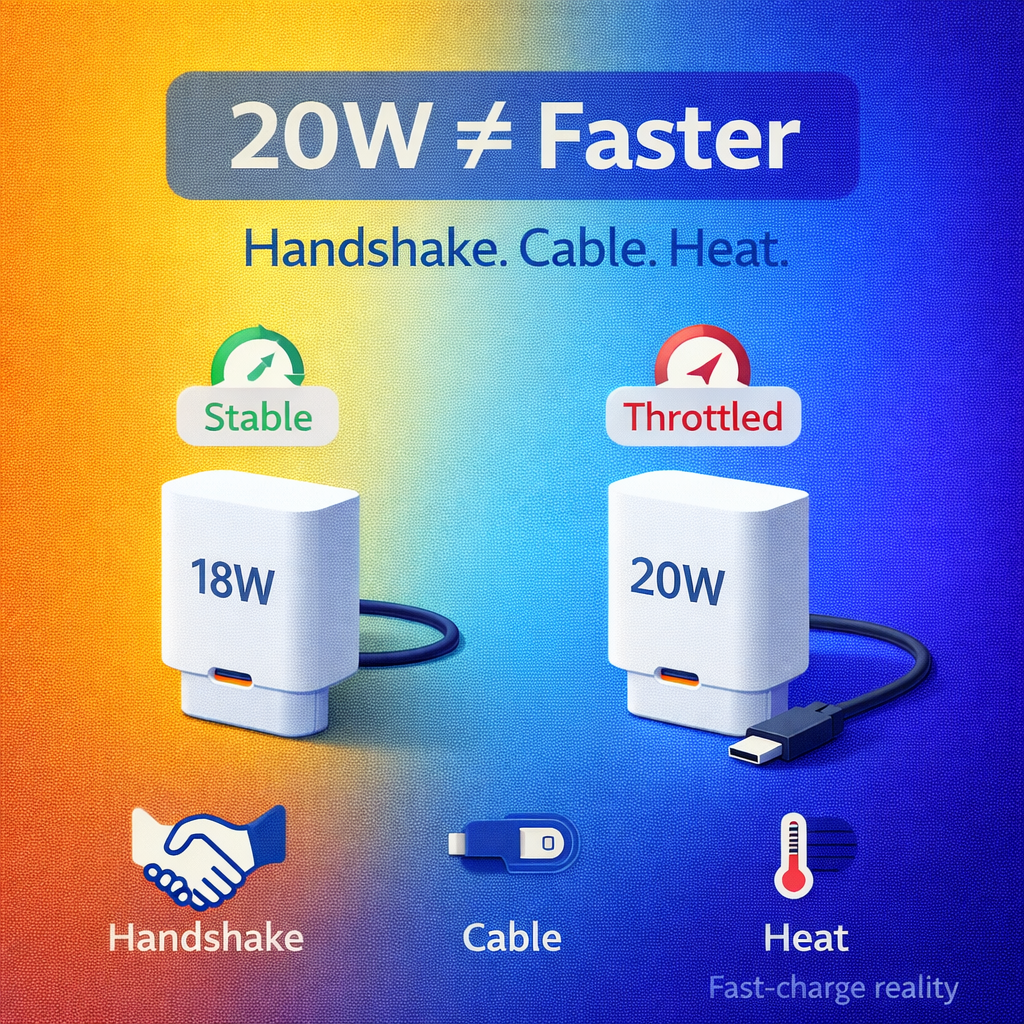
A 20W charger can feel slower than 18W because wattage is only a maximum. Real fast-charging speed depends on protocol negotiation between the phone and charger, cable resistance, battery charge stage, and thermal throttling when the phone gets hot. This article explains the handshake logic and a quick test to identify the real bottleneck.
Why 20W Feels Slower Than 18W: Fast-Charge Negotiation in Plain English
You plug in a "20W fast charger", but the phone does not feel faster than your old "18W charger". The number on the charger is a maximum. Real charging speed is decided by a negotiation between the phone, the charger, and the cable, plus heat limits.
Key Takeaway
"20W" is a ceiling. Real speed depends on protocol match, cable quality, battery stage, and temperature.
Why It Feels Slower
If the phone cannot negotiate the right mode, or heat forces throttling, higher watt labels do not translate into faster charging.
The Watt Number Is a Ceiling, Not a Promise
A 20W charger can deliver up to 20W, but it will only deliver what the phone asks for and what the charging mode allows. If the phone requests 15W, you get 15W. If the phone steps down due to heat or battery stage, you get less.
Fast Charging Is a Handshake, Not a Brute Force Push
Modern fast charging uses a "handshake" to agree on voltage and current. If the phone does not recognize a charger’s fast-charge protocol, it falls back to a safer, slower mode. Two chargers with similar watt labels can behave very differently depending on protocol support.
| What Changes | What You See | Why It Happens |
|---|---|---|
| Protocol mismatch | Charging works, but not "fast" | Phone falls back to a lower mode |
| Cable resistance | Warm cable, inconsistent speed | Voltage drop and extra heat cap current |
| Thermal throttling | Fast at first, then slows | Phone reduces power when it warms up |
The Cable Can Quietly Cap Your Speed
A weak or long cable adds resistance, which causes voltage drop and heat. The phone may reduce current to protect itself, especially if the connector is worn or the cable is not rated for higher current. This is why a new high-watt charger with an old cable can feel disappointingly slow.
Battery Stage Matters More Than People Expect
Charging is fastest when the battery is low. As it fills up, the phone reduces power to protect battery life and control temperature. If you test "speed" when the battery is already high, even a stronger charger will not look impressive.
The Speed Limiter That Wins Most Arguments
Heat overrides everything. A cooler 18W session can sometimes finish sooner than a hotter 20W session that keeps throttling.
A Quick 2-Minute Check to Find the Bottleneck
Use the same wall outlet, test the same battery range (for example 20% to 40%), and swap only one thing at a time: cable first, then charger. If speed changes a lot when you change the cable, the cable was the cap. If changing the charger changes nothing, the phone may not negotiate a higher mode with it, or it is already heat-limited.
The truth is simple: "20W" is a capability number, not your real charging speed. Real speed comes from protocol match, cable quality, battery stage, and temperature.
For stable fast-charging accessories designed for real-world performance, visit