Understanding Charging Protocol Negotiation in Simple Terms
- Share
- Issue Time
- Mar 2,2026
Summary
This article explains charging protocol negotiation in simple terms, showing how chargers and devices communicate to determine safe voltage and current levels. It clarifies why charging speed changes during a session and how compatibility affects stability and battery health.
Understanding Charging Protocol Negotiation in Simple Terms
Fast charging feels simple from the outside. You plug in a cable, and the battery percentage rises quickly. But behind that process is something called charging protocol negotiation, a communication system that decides how much power your device can safely receive.
Understanding this mechanism helps explain why the same charger can behave differently with different phones.
1) What is charging protocol negotiation
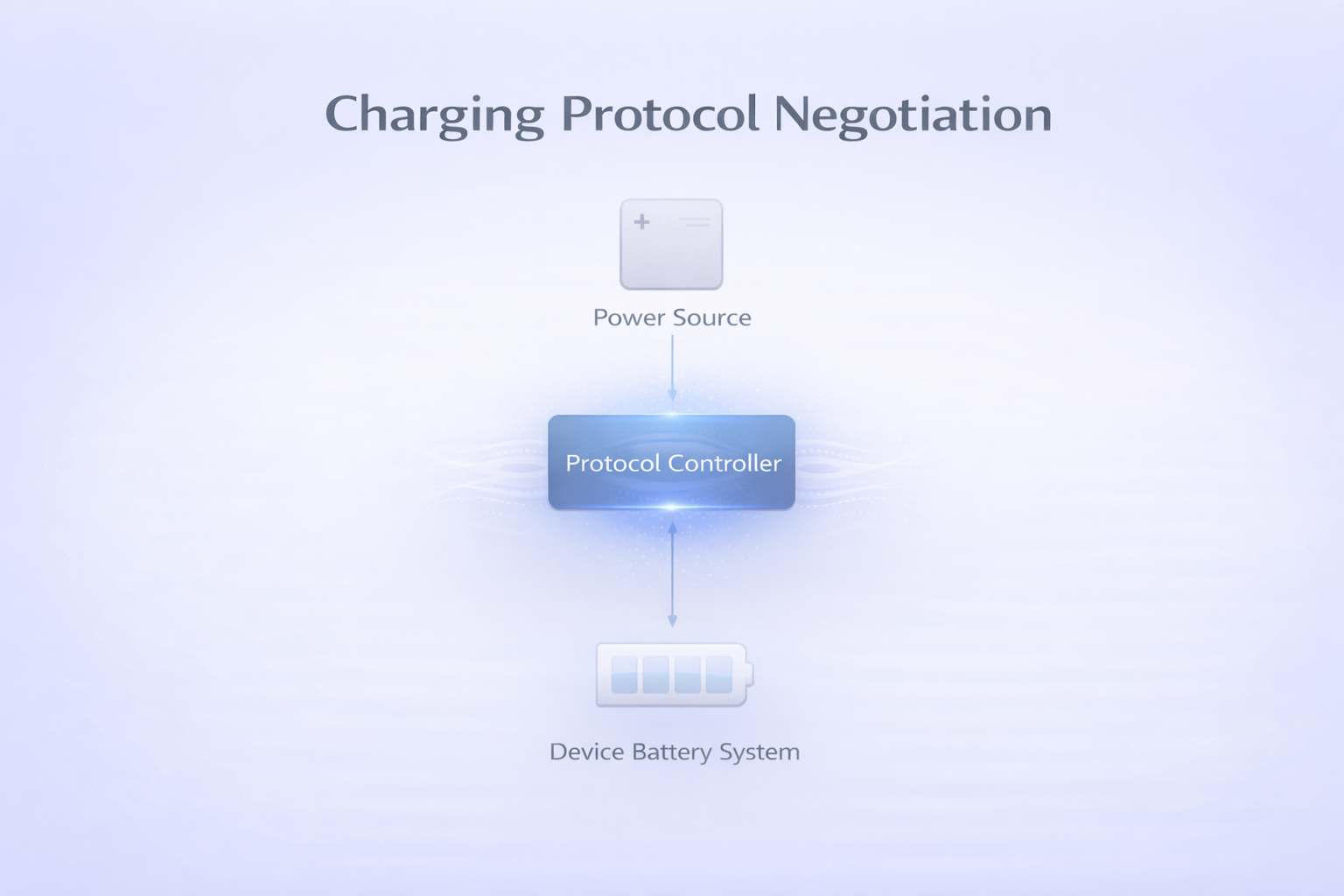
When you connect a phone to a charger, power does not immediately flow at maximum level. Instead, the charger and the device exchange information before higher power delivery begins.
2) Why negotiation is necessary
Lithium batteries are sensitive to voltage and temperature. Delivering too much power too quickly can cause overheating or long-term degradation. Protocol negotiation balances speed with safety.
3) What happens during fast charging
Most modern systems use protocols such as PD or PPS. While implementations differ, the logic is similar: the charger offers options, the device selects what it can safely use, and output is adjusted during the session.
4) Why charging speed drops after 50 percent
As the battery fills, internal resistance increases. The system reduces current and power to control heat and protect battery lifespan.
5) Why different chargers perform differently
Even if two chargers claim high wattage, real performance depends on protocol compatibility, cable quality, power stability, and circuit efficiency.
Practical takeaway
Charging protocol negotiation is not a marketing feature. It is a safety and efficiency system that balances speed, heat control, and battery health. Choosing compatible chargers, cables, and power banks helps ensure stable charging behavior rather than simply chasing the highest advertised wattage.