USB-C PD Explained: How Fast Charging Negotiation Really Works
- Share
- Issue Time
- Dec 26,2025
Summary
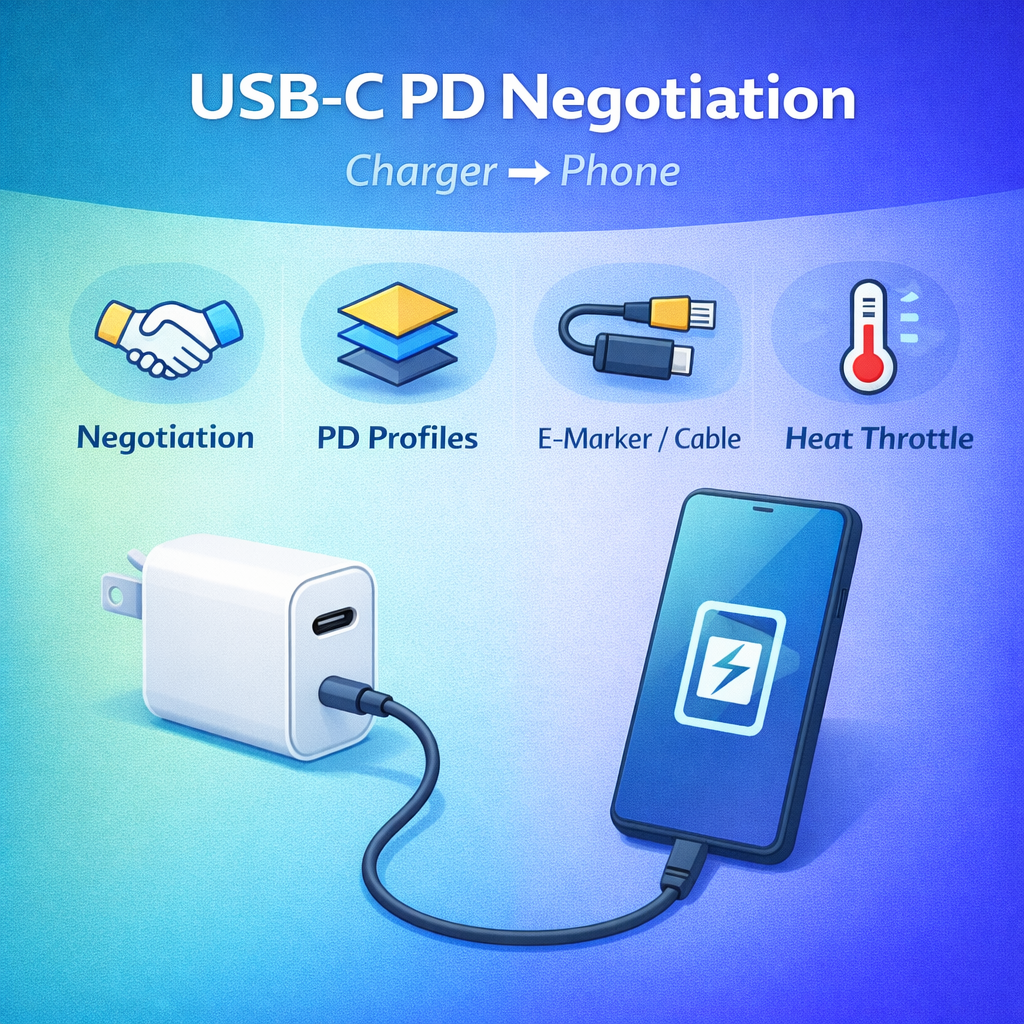
USB-C PD fast charging is controlled by a negotiation between the charger and the phone, with the cable and port acting as key limits. This article explains PD profiles, why E-Marker and cable current rating matter, and how heat and connector condition can cause charging to slow down or fluctuate.
USB-C PD Explained: How Fast Charging Negotiation Really Works
USB-C fast charging often feels mysterious. You plug in a charger, sometimes you get rapid charging, and sometimes it is slow or unstable. The reason is not just wattage. For USB-C Power Delivery (USB-C PD), charging speed depends on a short negotiation between the charger and the device, with the cable and port acting as critical gatekeepers.
Core Idea
USB-C PD uses communication to select a compatible power level, and the cable and port can limit what you actually get.
What Controls Speed
Device PD profiles, battery management, cable current rating, and connector condition determine real charging behavior.
What USB-C PD Actually Is
USB-C PD is a fast charging standard that allows a charger and a device to agree on how much power should be delivered. Instead of pushing maximum power all the time, PD uses communication to select a safe, compatible power level. This is why a charger with a high watt rating does not automatically force your phone to charge at that wattage.
The Negotiation Happens Before High Power Starts
When you connect a USB-C charger, the charger usually begins at a basic safe level. Then the device requests a higher power profile that it can accept. If both sides support the same PD profiles, power ramps up. If not, charging falls back to a lower level.
This negotiation is designed to protect the battery and prevent unstable or unsafe power delivery. It also explains why the same charger can behave differently with different phones.
Fast Charging In One Line
Charger offers, phone requests, cable and port allow, and the system adjusts to stay safe and stable.
Why The Cable Matters More Than People Think
In USB-C to USB-C charging, the cable is not always just a wire. Higher-power PD charging often relies on cable capability recognition. If the cable cannot reliably support the required current, the system may limit power to protect against heat and voltage drop.
Some higher-current USB-C cables include an E-Marker identifier, which helps the charger and device understand what the cable can handle. When cable capability is unclear, PD negotiation may choose a lower power mode even if the charger and phone are both capable.
What Your Phone Is Really Deciding
Even if the charger supports 65W or 100W, your phone may only accept a much lower level. The phone’s battery management system controls power intake based on battery temperature, state of charge, and long-term aging protection. Charging speed often slows down at higher battery percentages because the phone is actively protecting battery health.
Why PD Can Look Unstable In Real Life
PD charging can fluctuate due to heat, cable resistance, and port condition. If the connector is loose, dirty, or worn, voltage drop can increase and the system may reduce power to stay stable. In some cases, a phone may repeatedly renegotiate power when temperature changes, which can feel like charging cuts in and out.
How To Get More Consistent PD Fast Charging
Practical Checklist
- Use a USB-C PD charger that supports the profiles your device needs.
- Use a reliable USB-C to USB-C cable with appropriate current rating.
- Keep connectors clean and avoid loose ports.
- Expect charging speed to slow naturally at higher battery percentages.
Why This Works
PD is a system. If charger, cable, and device are well matched, negotiation reaches higher modes more reliably and stays stable under load.
When the charger, cable, and device are well matched, USB-C PD fast charging becomes predictable and stable. Understanding the negotiation process helps you troubleshoot speed issues and choose accessories that deliver consistent real-world performance.
To explore charging solutions designed for stable output and reliable USB-C PD compatibility, visit