USB-C Cable Ratings Explained: What 3A and 5A Actually Mean
- Share
- Issue Time
- Mar 1,2026
Summary
This article explains what 3A and 5A USB-C cable ratings actually mean, how current capacity affects charging speed and stability, and why choosing the right cable depends on charger output, device protocol, and overall compatibility.
USB-C Cable Ratings Explained: What 3A and 5A Actually Mean
When shopping for a USB-C cable, many users notice labels such as 3A or 5A printed on the packaging. At first glance, these numbers seem simple, but they directly affect charging speed, device compatibility, and even safety.
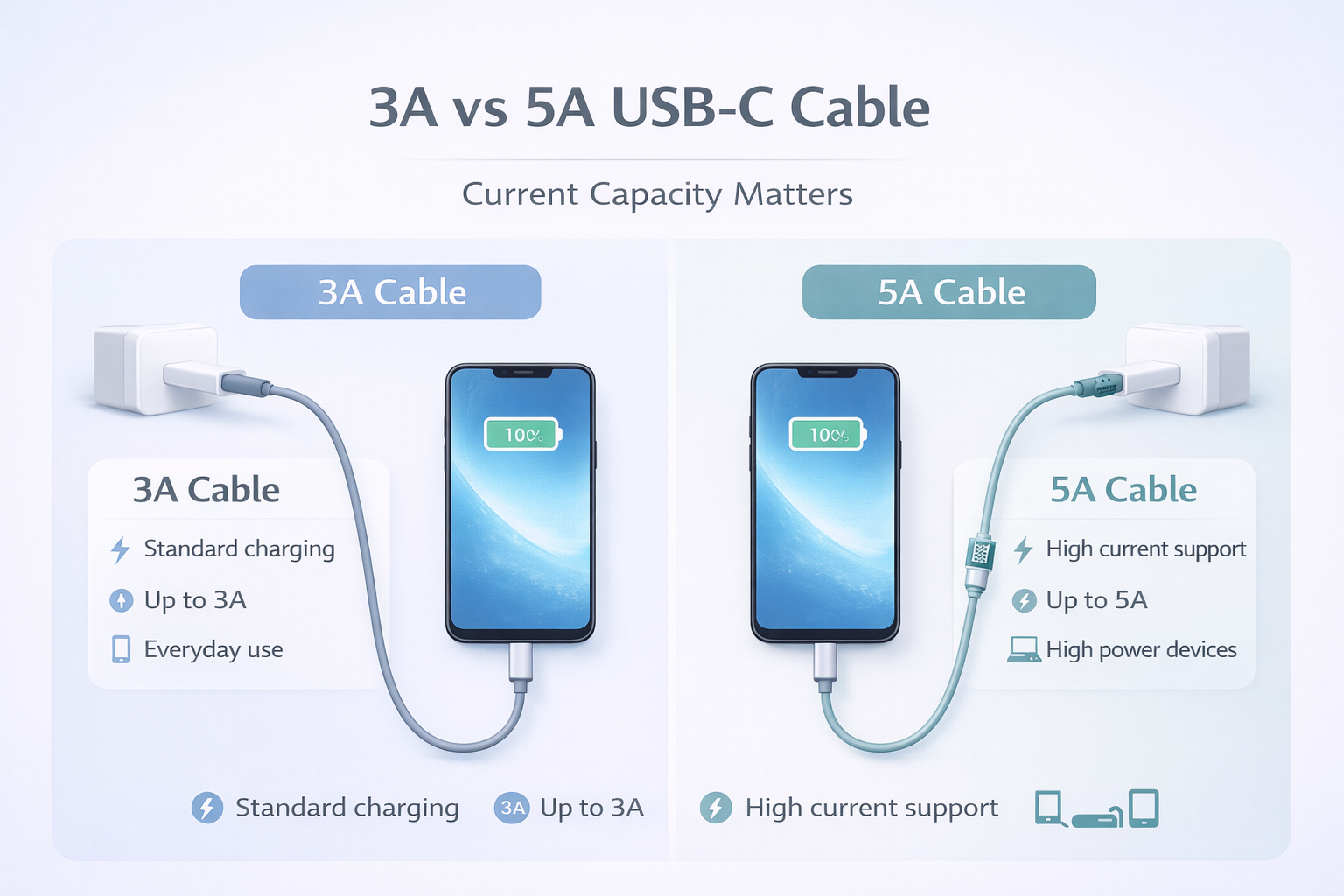
The "A" stands for ampere, which measures electrical current. In practical terms, a 3A cable is designed to safely carry up to 3 amps of current, while a 5A cable can handle up to 5 amps. The higher the current rating, the more power the cable can transmit, provided the charger and device also support it.
However, current rating alone does not guarantee faster charging. Charging speed depends on three factors working together: the charger’s output capability, the phone’s charging protocol, and the cable’s current capacity. If any one of these components limits performance, the overall charging speed will be reduced. For example, using a 5A cable with a charger that only outputs lower current will not increase speed.
Another key difference is that 5A USB-C cables typically include an internal identification chip, often referred to as an e-marker. This chip communicates with the charger and device to confirm that the cable can safely handle higher current. Without proper identification, high-power charging may be restricted by the system for safety reasons.
Cable construction also matters. Thicker internal conductors reduce electrical resistance, which helps minimize voltage drop and heat buildup. Poor-quality cables with high resistance may cause unstable charging behavior, slower speeds, or increased surface temperature during use.
For everyday charging, a 3A cable is often sufficient for most smartphones and standard power banks. A 5A cable becomes more relevant when using higher-watt chargers, fast charging protocols, or devices that support higher current input. Choosing the correct cable rating ensures that charging remains stable, efficient, and safe.
A simple way to choose between 3A and 5A
If you mainly charge a phone with a standard charger or a typical power bank, a well-made 3A USB-C cable is usually enough. If you use higher-watt chargers or devices that can draw higher current, a certified 5A cable with proper identification helps keep charging stable and controlled.
Understanding what 3A and 5A really mean helps users avoid relying solely on marketing claims and instead focus on compatibility and electrical design.