PD vs PPS Fast Charging: What Is the Real Difference
- Share
- Issue Time
- Mar 4,2026
Summary
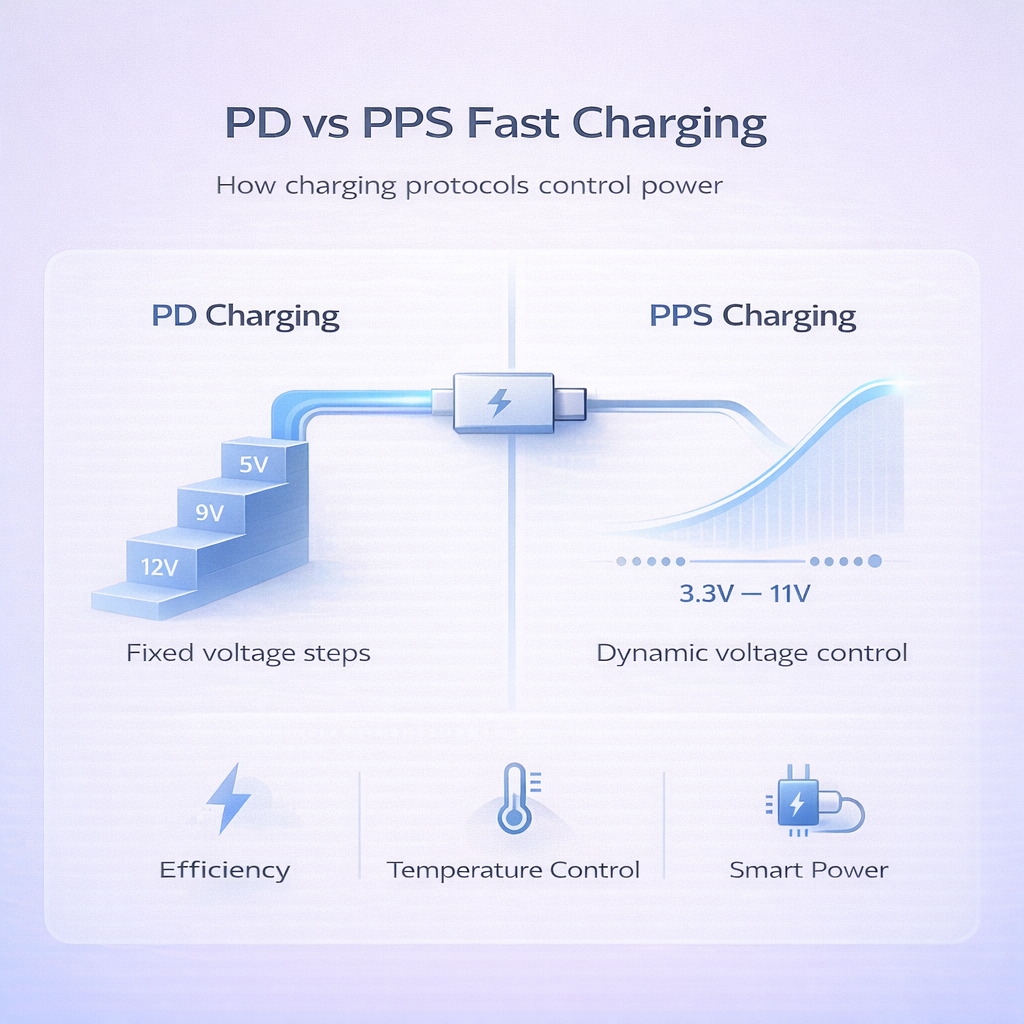
This article explains the difference between PD and PPS fast charging technologies. It highlights how PD uses fixed voltage steps while PPS enables dynamic voltage adjustment, which can improve charging efficiency and reduce heat in compatible devices.
PD vs PPS Fast Charging: What Is the Real Difference
Fast charging technologies have evolved rapidly over the past few years. Among the most commonly discussed standards today are USB Power Delivery (PD) and Programmable Power Supply (PPS). While both are widely used in modern smartphones and chargers, many users are still unsure how they actually differ.
Understanding the difference between PD and PPS helps explain why some devices charge faster, cooler, and more efficiently than others.
What is USB Power Delivery (PD)
USB Power Delivery is a widely adopted fast-charging standard developed by the USB-IF. It allows devices and chargers to negotiate higher power levels compared to traditional USB charging.
What is PPS charging
PPS is an extension of the USB Power Delivery standard. Instead of using only fixed voltage steps, PPS allows the charger to adjust voltage and current in small incremental steps during charging.
Why PPS can reduce heat
Heat is one of the biggest challenges in fast charging. Fixed-voltage charging sometimes requires the phone to internally convert voltage, which can generate additional heat. PPS reduces this problem by matching voltage more precisely to what the battery needs in real time.
Are all chargers compatible
Not every fast charger supports PPS. Many chargers only support standard PD profiles. If a device relies on PPS for optimal performance, a non-PPS charger may reduce speed or efficiency.
PD vs PPS at a glance
Conclusion
PD and PPS are both important technologies in the USB-C charging ecosystem. PD provides reliable high-power charging across a wide range of devices, while PPS introduces finer voltage control that can improve efficiency and reduce heat in compatible devices. Understanding these protocols helps explain why charging performance can vary based on the combination of charger, cable, and device.