GaN Chargers Explained: When They Help, When They Do Not
- Share
- Issue Time
- Dec 25,2025
Summary
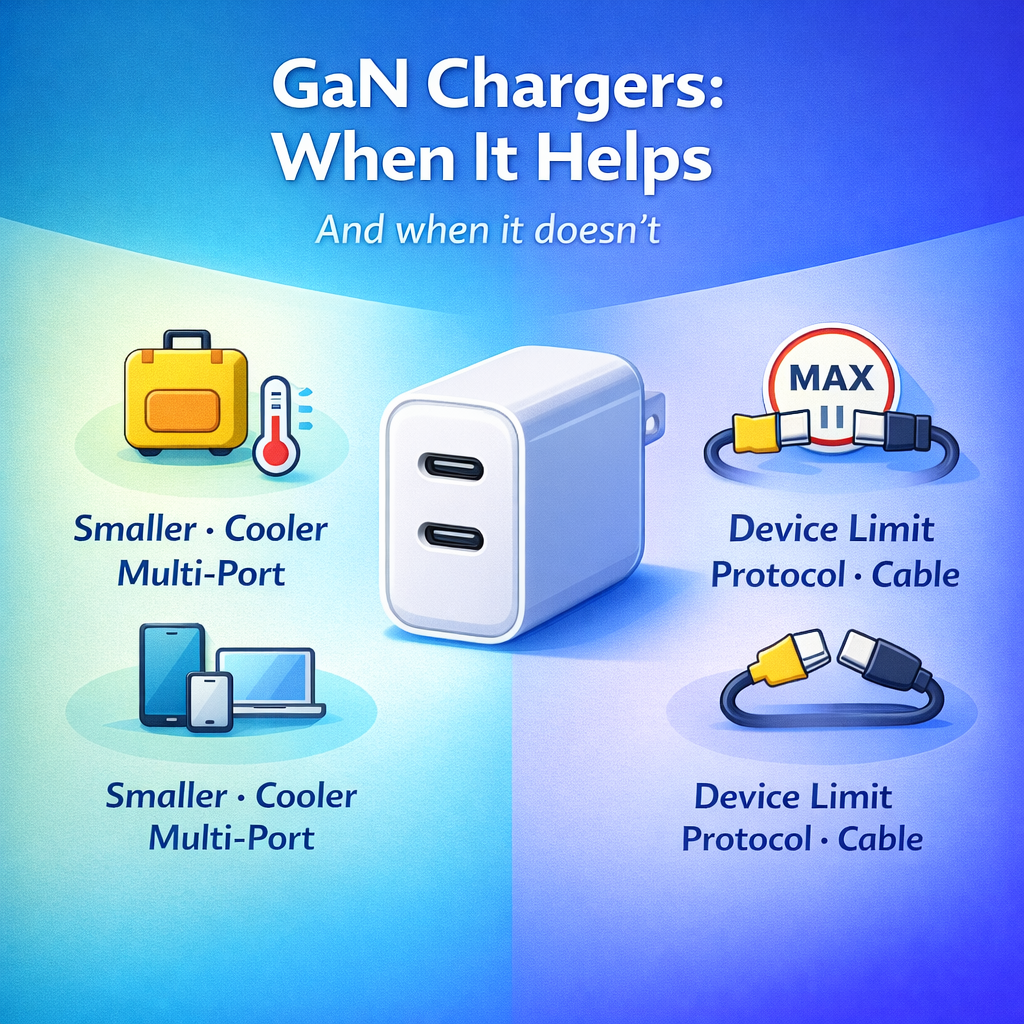
GaN chargers can be smaller and run cooler, helping maintain stable output under load, especially for travel and multi-port charging. This article explains what GaN changes inside a charger and why charging speed still depends on device protocols, power limits, and cable capability.
GaN Chargers Explained: When They Help, When They Do Not
GaN chargers have become one of the most talked-about upgrades in fast charging. They are usually smaller, cooler, and often advertised as more efficient than traditional chargers. But GaN is not a magic speed button. It is a power technology that helps in certain situations, and makes little difference in others.
Key Idea
GaN helps with size, heat control, and stability under load, but charging speed is still limited by device protocol and power acceptance.
Best Use Cases
Travel, compact setups, and multi-port charging where power distribution and heat matter most.
What GaN Actually Changes
GaN stands for gallium nitride, a semiconductor material used in power components. Compared with older silicon-based designs, GaN components can switch power more efficiently at higher frequencies. In practical charger design, that often means smaller transformers and less wasted energy as heat, which enables a more compact charger body.
When GaN Chargers Truly Help
GaN chargers are most useful when you care about size, heat control, and multi-port power management.
If you travel often, a smaller charger that can still deliver stable power is a real benefit. GaN designs also tend to handle heat better at higher power levels, which can help maintain more consistent output under load.
GaN can also be valuable in multi-port chargers. When you charge a phone and a laptop at the same time, smart power distribution and efficient power conversion matter more. A well-designed GaN charger can keep performance more stable when multiple devices are connected.
Quick Reality Check
A higher-watt GaN charger will not make a phone charge faster if the phone limits power intake or uses a different fast charging profile.
When GaN Does Not Change Your Charging Speed
Charging speed is ultimately limited by your device’s charging protocol and battery management. If your phone only accepts a certain power level, buying a higher-watt GaN charger will not make it charge faster. The device decides how much power to draw, especially as the battery approaches higher percentages.
GaN also does not automatically solve cable limitations. If the cable is not rated for fast charging or cannot support stable current, the charger may not reach the expected performance, regardless of whether it is GaN or not.
In addition, many people confuse GaN with fast charging standard. They are different. GaN is a design approach inside the charger. Fast charging depends on standards and compatibility such as USB Power Delivery, as well as the device’s supported profiles.
What To Look For Beyond The GaN Label
A good GaN charger is defined by real design quality, not the material name on the box. Look for stable output behavior, proper protection, and correct protocol support. For USB-C charging, confirmed USB Power Delivery support matters. For multi-port charging, pay attention to how power is shared across ports.
| Situation | GaN Helps Most | GaN Helps Least |
|---|---|---|
| Travel and compact setups | Smaller body, lower heat, stable output | If size is not important |
| Multi-device charging | Better power conversion and distribution under load | Single low-power device only |
| High-watt USB-C charging | Heat control and sustained output stability | Phone limits power intake anyway |
| Cable is weak or not rated | Helps less if current is limited by cable | Cable bottleneck dominates performance |
| Device uses strict protocol profiles | Still useful for stability and heat | Does not increase speed beyond device limit |
In real life, GaN chargers help most when you want a compact, cooler charger that stays stable under load, especially in travel and multi-device setups. If your device has strict input limits or your cable is the bottleneck, the difference may be minimal.
To explore charger solutions designed for stable output and reliable fast charging compatibility, visit