Fast Charging Cables: What Actually Changes Inside the Cable
- Share
- Issue Time
- Dec 23,2025
Summary
Two smartphone batteries can share the same capacity rating yet perform very differently in daily use. This article explains how cell quality, aging behavior, heat control, and system compatibility shape real battery performance beyond the numbers.
Fast Charging Cables: What Actually Changes Inside the Cable
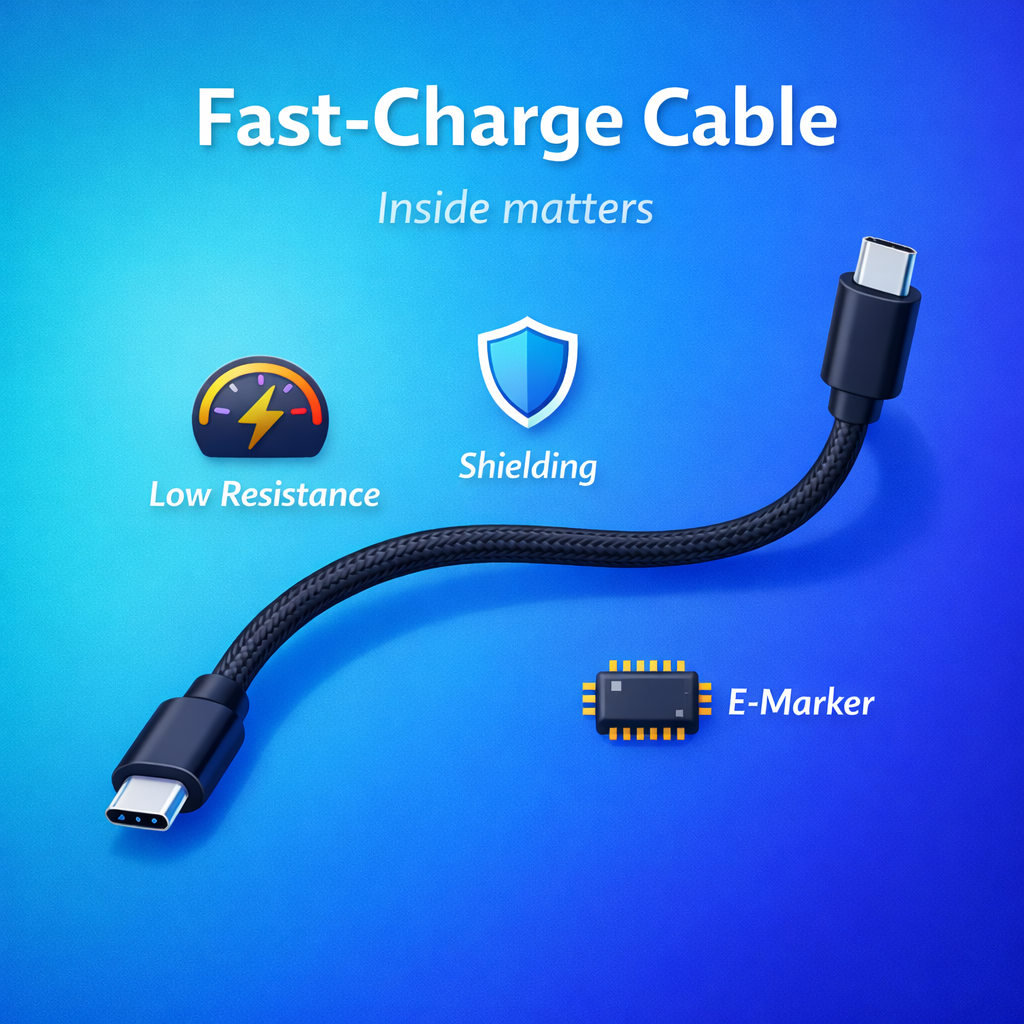
Fast charging often gets explained through charger wattage, but the cable matters more than most people think. Two cables can look nearly identical, yet deliver very different charging speed, stability, and heat. The difference is not magic. It is what changes inside the cable.
What Changes Inside
Conductor thickness, connector build, shielding, and cable identification all affect real charging performance.
Why It Matters
The right cable improves stability under load, reduces heat, and helps devices negotiate higher power safely.
A key factor is wire gauge and conductor quality. A fast charging cable typically uses thicker power conductors (lower resistance) to carry higher current with less voltage drop. Better copper quality and tighter manufacturing tolerances help the cable deliver power more efficiently, especially during high-load charging.
Inside many higher-end cables, you will also find improved insulation and shielding. These layers help maintain stable performance, reduce signal interference for data transfer, and improve durability under bending and daily use. This matters for USB-C cables that are designed to support both charging and reliable data communication.
Quick Reality Check
A cable can look the same outside but behave very differently under load because resistance, contacts, and internal design determine stability and heat.
Connector construction is another big difference. The metal contacts, internal soldering, and strain relief design affect both stability and lifespan. A cable may advertise fast charging, but if the connector is poorly built, it can cause intermittent charging, heat buildup, or a loose connection that reduces real performance.
| Inside The Cable | What It Affects | What You May Notice |
|---|---|---|
| Thicker conductors (lower resistance) | Less voltage drop under load | Faster, more stable charging |
| Better insulation and shielding | Lower interference, improved durability | Stable performance, fewer dropouts |
| Connector contacts and soldering | Contact stability and heat control | Less heat, fewer loose connections |
| Strain relief design | Bend resistance over time | Longer cable life |
| Cable identification (E-Marker) | Safe power negotiation for higher current | Better chances of reaching higher power modes |
For USB-C to USB-C fast charging, many higher-power cables include an E-Marker chip. This small component helps devices identify cable capability (such as 5A support) so that Power Delivery negotiation can safely enable higher power modes. Without proper cable identification, a phone or charger may limit output even if the charger is capable.
It is also important to understand that not every cable supports the same power level. Some are designed for standard charging, while others are built for high-power charging like a 100W USB-C cable. A cable that is not rated for higher current may still work, but it can reduce charging speed or run warmer under load.
Durability features can also be a meaningful divider. Braided charging cables, reinforced jackets, and stronger strain relief are often used to keep resistance stable over time. When a cable is repeatedly bent or stretched, internal damage can increase resistance and lower charging efficiency, even if the cable still works.
In real use, the best fast charging cable is not the one with the loudest claims. It is the one that matches your charger and device, supports the right power level, stays stable under load, and keeps heat under control. Understanding what changes inside the cable helps you choose a cable that performs consistently, not just on day one, but over months of daily charging.
To explore charging cable solutions designed for stable output and reliable fast charging performance, visit