Charging Overnight Myths: What Actually Damages Phone Batteries
- Share
- Issue Time
- Jan 15,2026
Summary
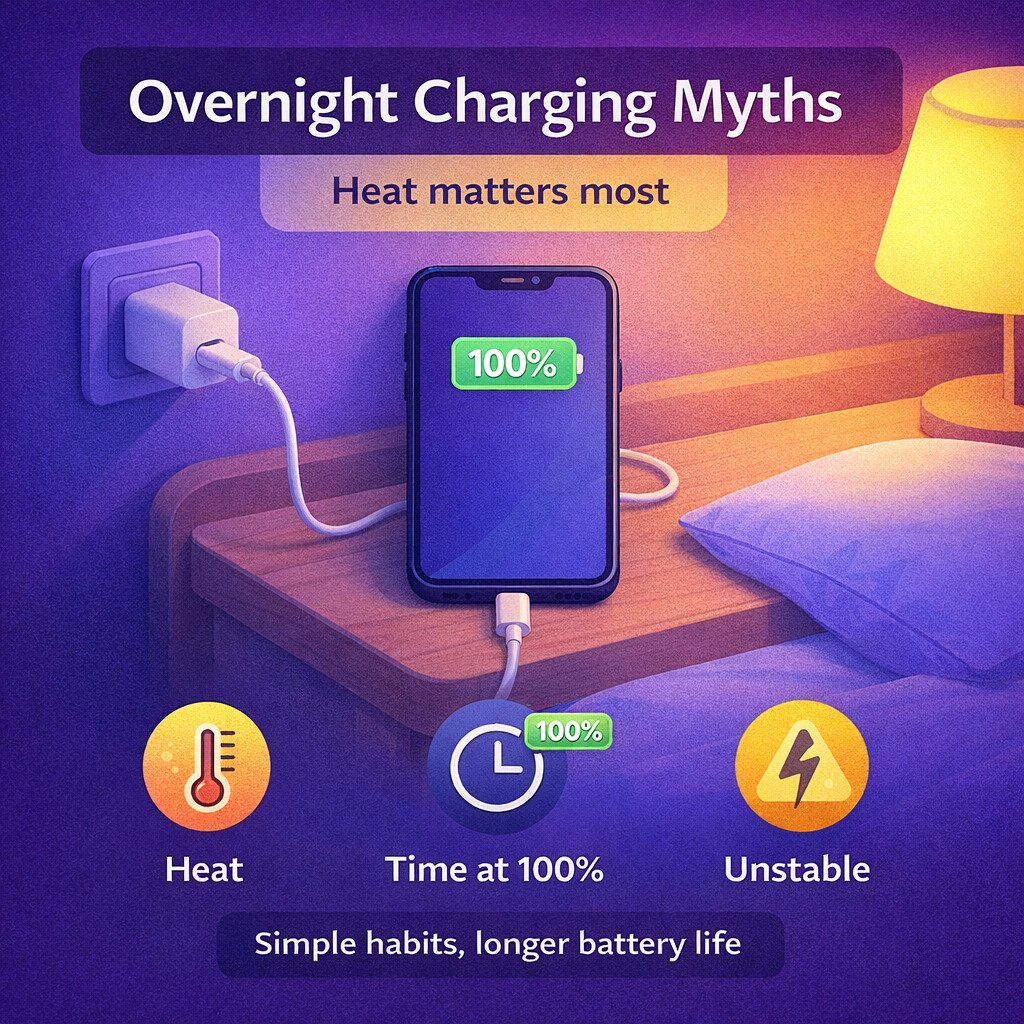
Overnight charging is not automatically harmful, because modern phones manage charging at full. Real battery damage usually comes from heat, long time spent near 100% charge, and unstable charging conditions caused by poor chargers, worn cables, or loose ports. This article explains what actually stresses lithium-ion batteries and the simplest habits to reduce overnight wear.
Charging Overnight Myths: What Actually Damages Phone Batteries
Overnight charging has a bad reputation, but the biggest battery damage usually does not come from the fact that you charge at night. It comes from heat, high state of charge for long periods, and poor charging stability. If you understand what actually stresses lithium-ion cells, you can charge overnight with far less risk.
The Myth
"Overnight charging overcharges the battery."
The Reality
Heat and long time near 100% are the real stress factors, especially with unstable charging setups.
Myth: "Overnight Charging Overcharges The Battery"
Modern phones do not keep forcing power into a full battery forever. Charging control is managed by the phone’s battery system. When it reaches full, it reduces or pauses charging, then tops up when needed. The real issue is not endless overcharging. The real issue is how long the battery stays near 100% and how hot it gets while doing so.
The Two Real Stress Factors: High Charge + Time, And Heat
Lithium-ion batteries age faster when they spend a long time at a high state of charge, especially near 100%. Add heat, and the aging accelerates. Overnight charging tends to create long time at high charge, and heat can be worse if you charge on a soft surface, under a pillow, or in a warm room.
| What Stresses The Battery | What It Looks Like At Night | Why It Matters |
|---|---|---|
| Long time near 100% | Phone sits "full" for hours | High state of charge accelerates aging |
| Heat while charging | Warm phone on soft surfaces | Heat plus charging increases wear |
| Unstable charging | Small connect-disconnect cycles | Adds unnecessary cycling and extra heat |
"Topping Up" Is Normal, But Unstable Power Can Make It Worse
Phones may sip small amounts of power overnight to maintain full charge. That is normal. However, unstable charging conditions can increase unnecessary cycling and heat, such as cheap chargers with noisy regulation, damaged cables that add resistance, or loose ports that create intermittent connect-disconnect behavior.
Fast Charging At Night Is Not Always The Best Idea
Fast charging is useful when you need speed, but it can increase heat. If you plug in at night, you usually do not need maximum speed. Slower, cooler charging is typically gentler on battery health. Some phones offer optimized charging features that delay the final push to 100% until close to your wake-up time.
The Hidden Villain
Charging while the phone is already hot is one of the fastest ways to accelerate long-term battery wear.
Practical Habits That Protect Battery Health
Keep the phone on a hard, ventilated surface, avoid thick cases if it runs warm, use a stable charger and a good cable, enable optimized charging if supported, and when possible aim for 80% to 90% daily instead of 100%. Overnight charging is not automatically harmful. The real damage usually comes from heat, high charge held for too long, and unstable charging setups.
For stable charging accessories designed for everyday battery care, visit