Charger Wattage Myths: 65W Is Not Always Better for Phones
- Share
- Issue Time
- Jan 27,2026
Summary
A 65W charger is not automatically faster for phones because wattage is only a maximum capability. Real speed depends on whether the charger supports the phone’s preferred fast-charging protocol (USB-C PD or PD PPS), the cable’s current rating, the battery’s charging stage, and thermal throttling when the phone or charger gets hot. This article explains why some lower-watt chargers can feel faster in real use and how to choose a charger that stays stable and cool.
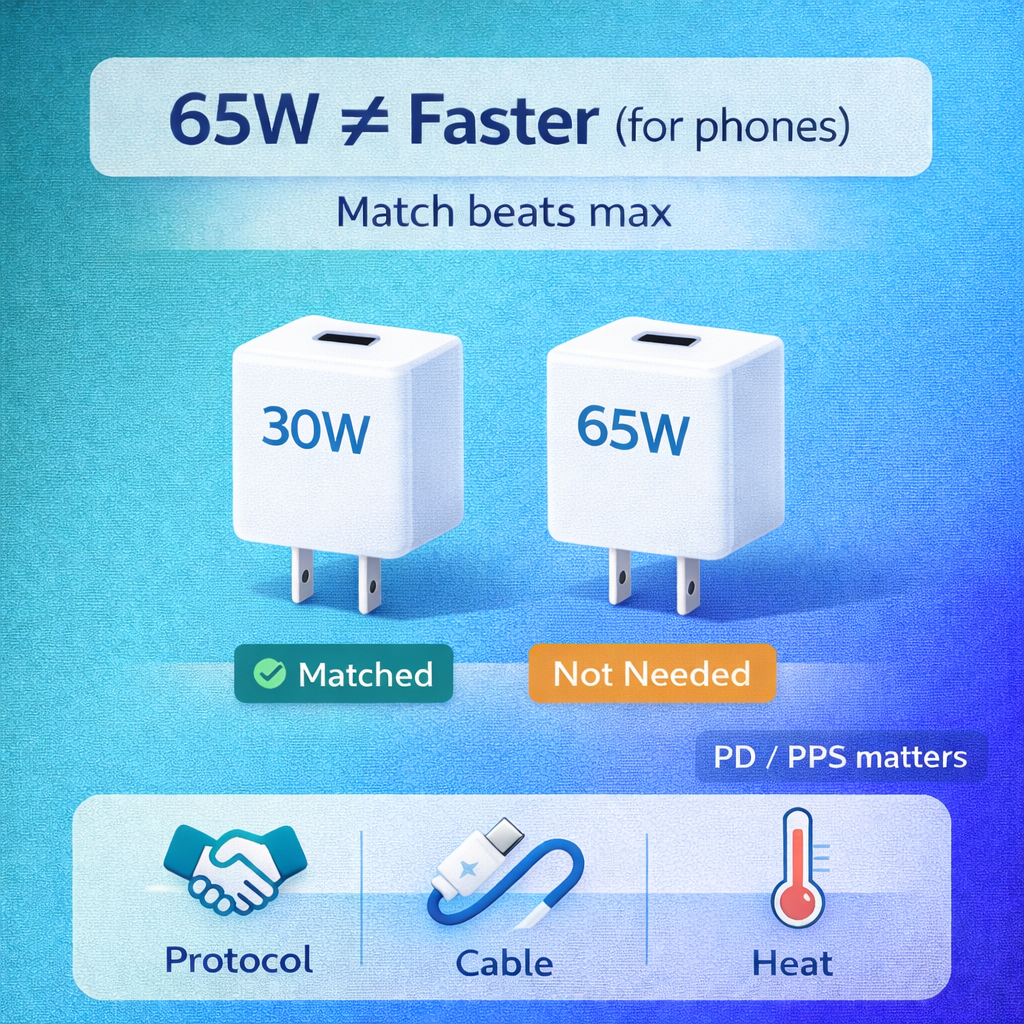
Charger Wattage Myths: 65W Is Not Always Better for Phones
A 65W charger sounds like it should crush a 20W charger. For laptops, that is often true. For phones, it is more complicated. Higher wattage is a capability, not a guarantee. Your phone will only take what it is designed to accept, and the best charger is the one that matches the phone’s charging protocol and keeps temperature under control.
The Myth
A bigger watt number automatically charges a phone faster.
The Reality
Phone speed depends on protocol match, cable capability, battery stage, and thermal throttling.
Wattage Is the Charger’s Limit, Not the Phone’s Demand
The number on the charger is the maximum it can supply. Phones decide how much power they draw. If your phone tops out at 18W, 25W, or 45W, plugging into 65W does not force it higher. The phone requests a specific voltage and current, and the charger responds.
Protocol Support Matters More Than the Big Number
Many phones prefer USB-C PD (Power Delivery) or PD PPS (Programmable Power Supply). A high-watt charger that does not support the phone’s preferred mode may fall back to a slower profile. Meanwhile, a lower-watt charger with the right protocol can feel faster because it negotiates the optimal charging step.
| What You Compare | What Can Change | What You Feel |
|---|---|---|
| 65W vs 20W on the box | The phone still draws its own limit | No visible speed gain |
| PD / PPS support | Higher or lower negotiated charging step | "Fast" vs "normal" charging |
| Temperature | Thermal throttling reduces power | Fast at first, then slows |
Heat Is the Real Performance Tax
Phones charge fastest when they are cool. If a charger runs hot, or if the phone is in a warm case or warm room, the phone throttles. In real life, a smaller charger that stays cooler can deliver a higher average speed across the full session.
Real-World Tip
A cooler 25W or 30W PD PPS charger can sometimes beat a hotter 65W charger in total time because it avoids repeated throttling.
Not All 65W Chargers Behave the Same
Two chargers both labeled 65W can have very different PD/PPS profiles and port behavior. Some share power between ports. Some reduce output on one port when another device is plugged in. Some advertise 65W but only at a specific voltage step that your phone never uses. The label does not tell the whole story.
When a 65W Charger Is Genuinely Useful for Phone Users
A 65W charger makes sense when you also charge a laptop or tablet, when it supports PD PPS and your phone can use it, when you want future-proof headroom, and when it has good thermal design with stable output under load.
A Simple Way to Pick the Right Charger
Check protocol support first (PD, PPS, or a brand-specific mode), then cable current rating, then real-world stability and temperature. If those are right, the watt number is just extra capacity, not the main reason it charges fast.
For stable, protocol-matched charging accessories designed for real-world performance, visit